
On this page
Your needs, this model
Does it fit your priorities?
Would you accept gasoline and a 50:1 premix, or is a battery handheld an easier fit?
The PB-2520 manual requires a 50:1 mix, 89-octane unleaded fuel and a recoil/choke/purge-bulb start, with a three-minute warm-up. Because exact-model safety eligibility is unresolved, it remains a technical reference rather than a purchase choice. If battery handheld is acceptable and 880 CFM is a useful threshold, the separately documented EGO LB8803-2 is a current alternative; it is a different power and operating plan.
Explore this need in the finder →Is low carrying weight more important than keeping the PB-2520 gasoline format?
The PB-2520 manual lists 8.6 lb dry with its pipes and 7.9 lb without them, before fuel. If a battery handheld is acceptable, the EGO LB7654 is listed at 4.6 lb body weight; that is not a battery-installed operating weight, and its performance is a separate setup. The PB-2520 is reference-only and cannot be used as a purchase match.
Explore this need in the finder →Do you need to vacuum and bag leaves rather than blow them into a pile?
The PB-2520 manual lists blower pipes only, not a vacuum tube or collection bag. If leaf collection is essential and battery power works for you, EGO LV5000 and LV5005 have separate vacuum/mulcher operating plans; a gas blower should not be treated as a substitute for that function.
Explore this need in the finder →A lighter gas handheld with a curved tube
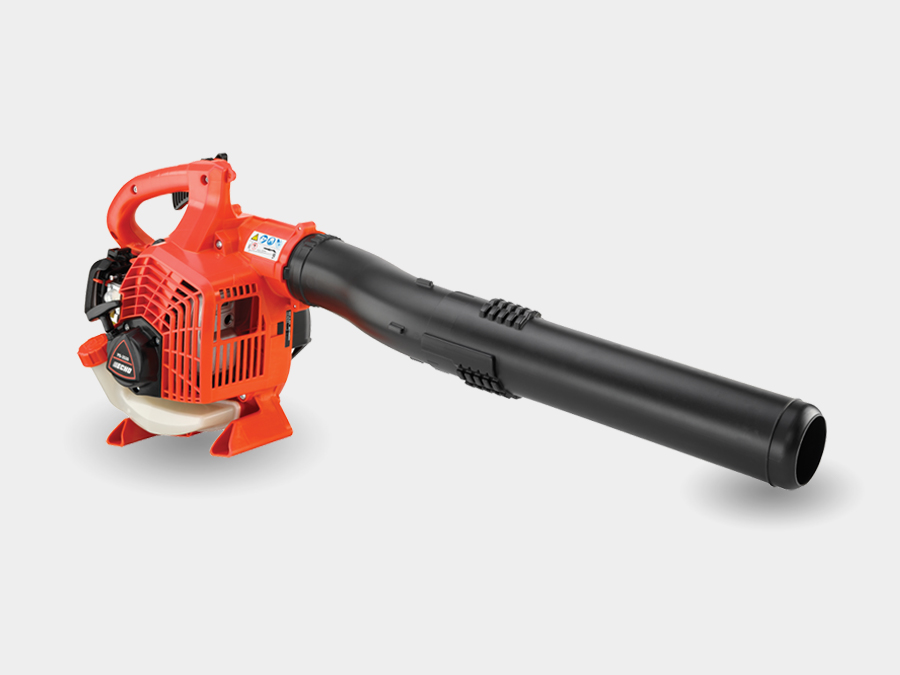
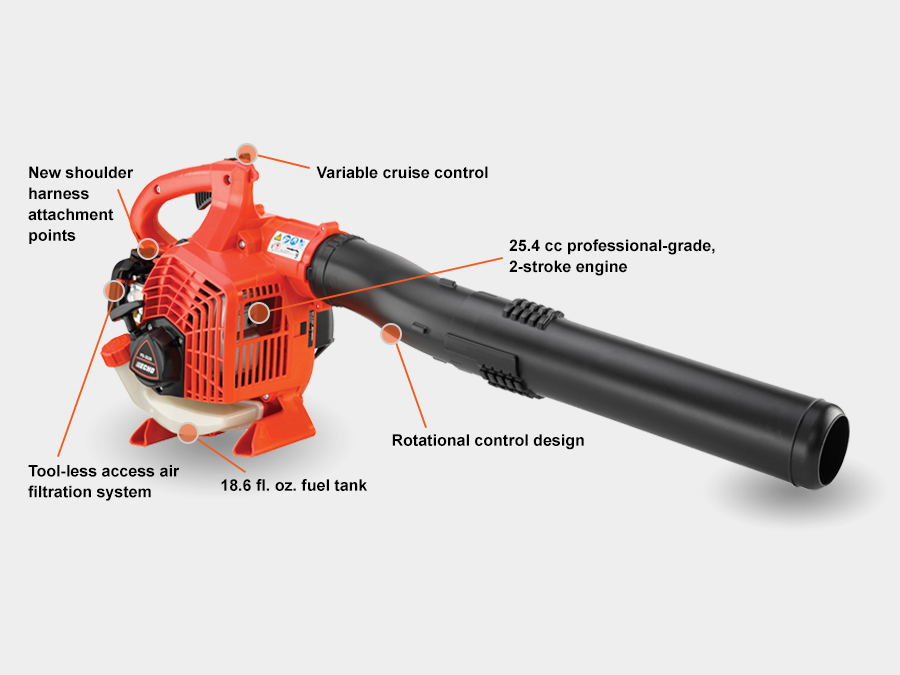
The ECHO PB-2520 is a 25.4 cc, two-stroke gasoline handheld blower. ECHO describes its curved tube as a rotational-control design and lists variable cruise control, Posi-loc pipe connections, tool-less filter access and shoulder-harness attachment points. The harness is sold separately. That mix points toward someone who wants a compact engine blower and is comfortable with routine fuel preparation, starting and engine care, rather than someone seeking a battery-free-maintenance tool or a vacuum-and-bag kit.
The performance headline is 453 CFM and 170 mph with pipes, published on ECHO’s product page, support specification table and the current PB-2520 manual. ECHO’s page also lists 15.8 N, but the manual and support specifications do not repeat that force number. Treat it as a product-page-only claim, not a manually confirmed force threshold. The manual does not break its 453-CFM/170-mph pair into nozzle-specific pipe results, so the finder does not credit the supplied pipes as round, flat or tapered nozzles. ECHO identifies a curved tube; shape labels should not be guessed from an image.
How it differs from the PB-2620
Both models use a 25.4 cc two-stroke gasoline format, but their published body weights and tank sizes diverge. The PB-2520 weighs 8.6 pounds dry with pipes, or 7.9 pounds without them, and its tank holds 18.6 fluid ounces. The PB-2620 manual lists 9.8 pounds dry with pipes and a 20.3-ounce tank. Those are like-for-like manufacturer bases, not fueled working weights. The PB-2520 therefore trims listed dry mass and carries less fuel; it does not eliminate refueling or make a full operating weight known.
The PB-2620’s output is listed by pipe: 456 CFM/172 mph with the round pipe and 428 CFM/180 mph with the flat pipe. The PB-2520 has one 453/170 pair “with pipes,” not the same nozzle detail. The numbers sit near the PB-2620 round-pipe figures, but they are not a controlled comparison of identical attachments. Choose based on the documented arrangement and the ownership differences you actually value, not a small headline-number gap presented as a predicted clearing-time difference.
Fuel, starting and maintenance are part of the choice
The current PB-2520 manual calls for 50:1 gasoline-to-two-stroke-oil fuel, with 89-octane unleaded gasoline and oil meeting the stated ISO-L-EGD and J.A.S.O. M345-FD standards. It excludes methanol, more than 10% ethanol, more than 15% MTBE and alternative fuels such as E-15 or E-85. That means measuring and storing mixed fuel correctly, keeping it fresh and following local fuel-storage rules. The tank size is not a runtime estimate; the manufacturer does not publish a job duration that can be inferred from 18.6 ounces.
Cold starting is manual: set the stop switch and throttle-position lever, close the choke, use the purge bulb and pull the recoil starter. ECHO says to allow a three-minute warm-up before work. The manual also warns against continuous low-speed operation, calls for at least five minutes at wide-open throttle each hour, and recommends inspecting or cleaning the spark-arrester screen at roughly 40 hours. Those steps make the gas format a poor fit if you want a tool that simply takes a charged battery and starts with a switch. The product is also a blower, not a collection system; the manual contents list two blower pipes, not a vacuum tube or bag.
Weight, fit and alternatives
At 8.6 pounds dry with its pipes, the PB-2520 is still a handheld engine tool, and a filled tank adds weight. Its separate shoulder-harness attachment points do not mean a harness is included. ECHO lists 70 dB(A) at 50 feet under ANSI OPEI B175.2; that measurement distance is not a promise of a quiet sound level at the operator, and hearing protection remains in the manual’s safety guidance. The double-grid intake and tool-less access may ease inspection, but dusty work still calls for filter maintenance.
If the fuel routine is the deal-breaker, the battery EGO LB5302 is a different handheld path; its battery system avoids premixing fuel but brings charging and battery-package choices. For a much higher published airflow requirement, EGO’s LB8803-2 is a distinct 880-CFM handheld kit, not a direct substitute for the PB-2520’s engine character or weight basis. If you want to collect leaves rather than blow them, EGO LV5000 and LV5005 are separate battery vacuum/mulcher configurations. These alternatives change both the power source and the work plan, so do not compare a blower-only PB-2520 against them as if all three performed the same job.
Who should keep it in the comparison
Keep the PB-2520 in a technical comparison if you want a 25.4 cc gas handheld, a curved tube that ECHO says supports rotational control, and the manufacturer’s 453-CFM/170-mph with-pipes listing. It is less appropriate if you need a confirmed operating weight, a particular supplied nozzle class, leaf collection, or a battery-powered start. The support table’s wide-open-throttle figure differs from the November 2025 manual, and the product-page carburetor label also differs from the manual and support wording; neither detail is used to promise performance here. For setup, use the manual matching your serial range.
This page is a technical reference, not a purchase recommendation: exact-model safety eligibility has not been established, and that is not a recall finding or a clearance statement. The current manual identifies six serial ranges; check the unit’s serial number and current manufacturer notices with ECHO or an authorized dealer before relying on a specific unit’s status.
ECHO PB-2520 product page · ECHO PB-2520 support specifications · ECHO PB-2520 technical documents
Key details at a glance
| Maximum published air volume | 453 CFM |
|---|---|
| Manufacturer-listed sound level at 50 ft. | 70 dB(A) |
| Manual-listed maximum air speed | 170 mph |
| Manufacturer-listed tool weight (check basis) | 8.6 lb |
| Batteries in this kit | 0 |
| Nozzles in the kit |
More specifications and setup details
| Limited warranty | Current product page presents consumer and commercial warranty terms; no purchase date or individual unit eligibility inferred. |
|---|---|
| Exact package configuration | November 2025 manual contents list one power head, two blower pipes, warranty statement and quick-start guide; no battery, charger or shoulder harness is listed. |
| String trimmer in kit | No |
| Leaf vacuum and mulching function | No |
| Battery included in package | No |
| Charger included in package | No |
| Blower carrying style | Handheld |
| Power source | Gasoline |
| Engine displacement | 25.4 cm³ |
| Fuel tank volume | 0.55 L |
| Gasoline tank capacity | 18.6 oz |
| Two-stroke fuel mixture | 50:1 gasoline/two-stroke oil; use oil meeting ISO-L-EGD and J.A.S.O. M345-FD specifications. |
| Weight measurement basis | Manual dry weight is 8.6 lb with blower pipes / 7.9 lb without pipes; it excludes gasoline and does not establish full operating weight. |
Use the exact model’s instructions for operating limits, supplied equipment and version differences.
Sources for this assessment
- ECHO U.S. PB-2520 handheld blower product page
- ECHO support specification table for PB-2520
- ECHO PB-2520 Operator’s Manual X7501193100, November 2025
- ECHO PB-2520 / PB-2620 Quick Start Guide
- ECHO technical-documentation filter for PB-2520
- Official ECHO PB-2520 main product-page JPEG
- Official ECHO PB-2520 feature image

Match the blower to your yard and routine.
Compare the exact kit, controls, nozzle and carrying setup before choosing.