
Your needs, this model
Does it fit your priorities?
Do you prefer a tube-mounted trigger for a gasoline backpack blower, instead of reaching for a hip-mounted throttle?
The PB-580T has the tube-mounted variable-speed trigger and throttle-position lever; the PB-580H moves its speed lever to the hip. Their published 517 CFM / 216 mph maxima are shared, so the T fits for control placement, not extra power.
Explore this need in the finder →Would a battery backpack be acceptable if avoiding 50:1 fuel preparation and recoil starting matters more than using a gasoline engine?
If battery power is essential, the PB-580T does not fit. Reviewed EGO LB6000-family battery backpacks avoid gasoline mixing and recoil starting but publish a different 600 CFM maximum and require charged compatible batteries.
Explore this need in the finder →Can a 22.7 lb dry-with-pipes limit work for the tube-control layout before fuel is added?
ECHO lists the T at 22.7 lb dry with standard pipes; its support table separately gives 20.5 lb without pipes. A 22.7 lb maximum admits the listed pipe-equipped dry weight, while 22.6 lb does not. Filled operating weight is not provided.
Explore this need in the finder →For the T, keep speed control at the blower tube
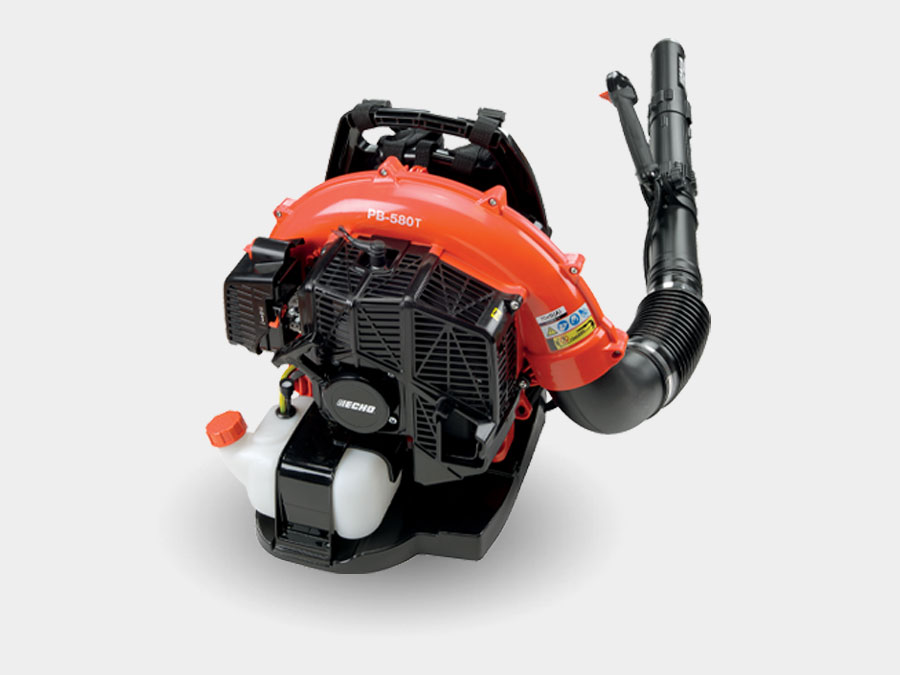
The PB-580T is ECHO’s tube-mounted-control configuration in the PB-580 backpack family. Its trigger is at the tube grip, with a throttle-position lever for sustained speed; the PB-580H puts its variable-speed lever at the operator’s hip. ECHO rates the two alike for displacement and blower output, so the T is not a higher-powered PB-580. The point is to decide where your hand should change speed while the nozzle is directed at the job.
Airflow is shared with the H
ECHO lists 517 CFM at the nozzle and 216 mph for the PB-580T. Its page also gives a 22 N maximum blowing-force value under ANSI B175.2-2012. Those are published maxima, not measured yard-clearing times; 22 N appears on the product page/catalog but not as a manual-listed force figure in the operator/support tables. If your hard requirement is a force value specifically listed in the manual, leave this configuration unqualified rather than converting the page number into that different evidence.
The H and T use the same 58.2 cc two-stroke engine and the same manufacturer-listed output. The T’s product page calls out a tube-mounted variable-speed trigger and cruise control. The manual explains that the trigger controls engine speed, or the throttle-position lever can set speed for continuous use. That arrangement can suit a person who wants the control to remain beside the hand guiding the blower pipe. Someone who prefers the lever at the hip should compare the H, not assume the T offers a different blower mode.
It is a backpack machine, but not a light one
ECHO lists 22.7 lb dry with standard pipes for the T. The support specification table separately shows 20.5 lb dry without pipes. These figures have different equipment bases, and neither is a fueled, ready-to-work weight. The H is 22.9 lb with pipes and 20.7 lb without them; that 0.2 lb difference should not drive the choice by itself. ECHO lists a padded backrest, shoulder straps and a vented back pad, while the model’s Posi-loc pipes, leaf guard, metal wear ring and pleated air filter are intended for regular blower work. Fit the harness and hand control to your body and routine rather than treating “all-day comfort” as a measurable guarantee.
The product is a blower rather than a vacuum/mulcher. Its documented pipes move debris away; there is no collection bag or shredder in the PB-580T plan. If your cleanup depends on bagging leaf litter at the tool, compare an actual blower-vacuum product and its separate attachments instead of expecting this backpack to collect material.
Fuel and start-up are part of the purchase
PB-580T uses a 62 fl oz fuel tank and a 50:1 gasoline/oil mixture. ECHO specifies 89-octane unleaded gasoline and two-stroke oil meeting its listed standards, with restrictions that rule out E-15 and E-85 and set limits for alcohol/MTBE. The standard starter is a recoil system; ECHO’s manual shows a choke and purge bulb in the start-up process. There is no included battery or charger and no electric-start convenience to count on. For occasional short sessions, the setup and storage of mixed fuel may matter more than the difference between a tube trigger and hip lever. A battery backpack changes that operating plan but also requires compatible charged batteries.
ECHO reports 70 dB(A) at 50 feet under ANSI B175.2. Do not read that as the sound beside the operator. The manual calls for hearing and eye protection, keeping people at least 50 feet away, avoiding exhaust exposure, and following local noise-hour rules. It recommends lower speed for dry leaves on walks and drives, and says not to use more throttle than needed. This is meaningful for neighbors and dust control, but it does not make the PB-580T suitable where a municipality prohibits gas blowers or where a low-noise model is essential.
Compare by the job, then by the hand control
For a 58.2 cc backpack with tube control, the PB-580T suits repeated yard cleanup and heavier leaf movement more than a tiny patio touch-up. It weighs around 23 lb with pipes before fuel and needs correct mixing, recoil starting and engine maintenance. If a hip lever fits your routine, the PB-580H shares the engine, CFM and air-speed ratings. If an airflow minimum is much higher than 517 CFM, ECHO’s PB-770T publishes 756 CFM and brings a larger engine and more weight. If battery power is essential, EGO LB6000-family backpacks publish a different 600 CFM maximum and avoid fuel mixing, but add battery/charging logistics.
The U.S. PB-580T product page and serial-specific parts catalogs keep the T separate from the H, and ECHO’s current listing is not proof of stock at a nearby dealer. On a used machine, identify the model and serial before relying on a manual or parts diagram. ECHO’s captured recall index had no PB-580 listing, but it is not a unit-specific clearance; ask a dealer about the actual serial if safety history is uncertain.
ECHO PB-580T product page · ECHO PB-580H/T support specifications · PB-580T technical documents · Current PB-580H/T operator’s manual
Key details at a glance
| Maximum published air volume | 517 CFM |
|---|---|
| Manufacturer-listed sound level at 50 ft. | 70 dB(A) |
| Manual-listed maximum air speed | 216 mph |
| Manufacturer-listed tool weight (check basis) | 22.7 lb |
| Batteries in this kit | 0 |
| Shoulder strap included | Yes |
| String trimmer in kit | No |
| Leaf vacuum and mulching function | No |
| Battery included in package | No |
| Charger included in package | No |
| Blower carrying style | Backpack |
| Backpack support harness | Yes |
| Power source | Gasoline |
| Engine displacement | 58.2 cm³ |
| Fuel tank volume | 1.83 L |
| Air volume at pipe | 517 CFM |
| STIHL Easy2Start | No |
| Gasoline tank capacity | 62 oz |
| Two-stroke fuel mixture | 50:1 gasoline and two-stroke air-cooled engine oil meeting ECHO's listed ISO-L-EGD and J.A.S.O. M345-FD specifications. |
| Product-page maximum air velocity | 216 mph |
| Manufacturer-listed weight | 22.7 lb |
| Weight measurement basis | Exact T product page says 22.7 lb dry with standard pipes. ECHO Support separately lists 20.5 lb dry without pipes. Neither figure includes fuel or represents ready-to-work weight. |
| Throttle control location | tube |
Use the exact model’s instructions for operating limits, supplied equipment and version differences.
Sources for this assessment
- ECHO U.S. PB-580T product page
- ECHO Support PB-580H and PB-580T specifications
- ECHO U.S. technical-document list filtered to PB-580T
- PB-580H/T Operator's Manual X7505201800 (05/25), latest listed P638/P639/P640/P641/P642/P643 serial ranges
- PB-580T Parts Catalog, newest listed P642 serial family
- ECHO Backpack Blower Quick Start Guide for PB-265LN/PB-580 H/T/PB-755S H/T/PB-760LN H/T/PB-770 H/T built after 1/1/2024
- ECHO PB-580T image embedded in the exact T product page
- ECHO U.S. Product Recall filtered technical-document list, captured for PB-9510 research on 2026-10-24 and reused here

Match the blower to your yard and routine.
Compare the exact kit, controls, nozzle and carrying setup before choosing.