
Your needs, this model
Does it fit your priorities?
Do you need a gas backpack blower whose variable-speed control is at the hip rather than on the tube?
The PB-755SH exact U.S. page and its shared PB-755S H/T manual identify the hip-mounted layout. The PB-755ST is the tube-control alternative; both share the 755 family’s published airflow, so the suffix is a handling decision.
Explore this need in the finder →Would a manufacturer-listed sound rating of 74 dB(A) at 50 feet fit your ceiling?
ECHO lists 74 dB(A) at 50 feet for the PB-755SH, and the 2023 shared manual gives the same figure. A 74 dB(A) limit admits the published rating; a 73 dB(A) limit does not. This is not an ear-level measurement or a local-noise approval.
Explore this need in the finder →Is 651 CFM enough as your minimum published air-volume requirement?
The current PB-755SH product page lists 651 CFM, while the shared manual and ECHO support table say 653 CFM. The profile uses the conservative current-page value as its matching floor: 651 passes, 652 does not. Neither number predicts clearing time.
Explore this need in the finder →The PB-755SH is the hip-control member of ECHO’s 63.3 cc backpack line
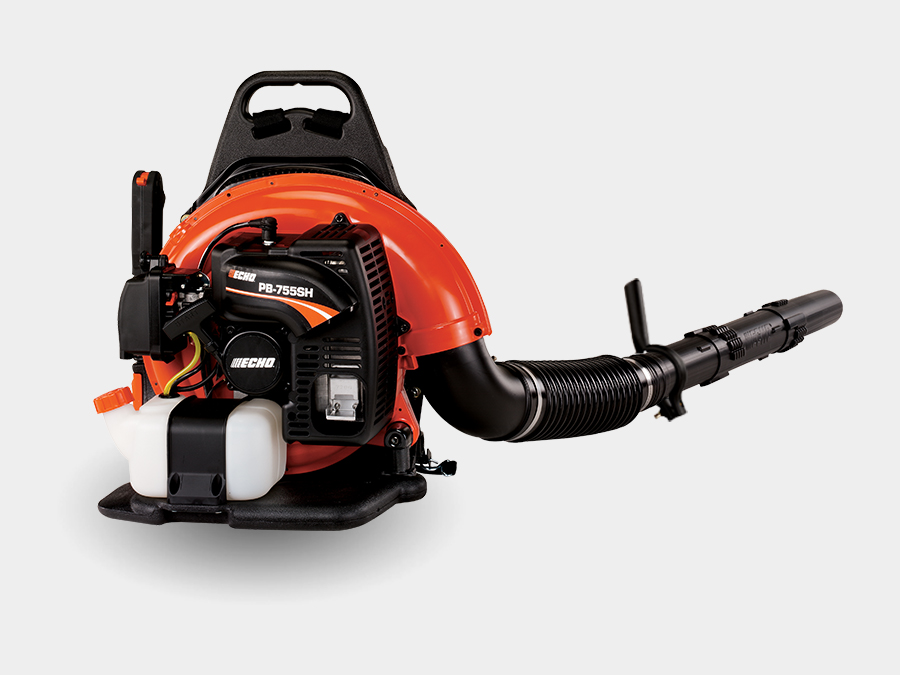
The PB-755SH is a two-stroke gasoline backpack blower with its variable-speed throttle mounted at the operator’s hip. The matching PB-755ST puts the control on the tube instead. Both are versions of the same basic blower family; the suffix changes how your hand reaches the speed control, not the fuel system or the reason to choose this model. ECHO’s current U.S. product page lists 651 CFM and 233 mph, while the shared PB-755S H/T operator’s manual and ECHO support specification table list 653 CFM and 233 mph. The safe comparison is therefore a published 651-CFM minimum for matching, with the 653-CFM manual/support figure retained as a source difference. Neither figure is a yard-clearing-time test.
What hip-mounted control changes on a long pass
The SH has a speed lever at the operator’s hip and a cruise-control function. You can reach the speed control without moving your hand from the hip area to the tube grip. That layout may suit someone who prefers a less busy grip or expects to set a working speed and continue along a route. The tube still needs to be guided and aimed; this does not make the blower self-steering. In ECHO’s shared manual, the H operating steps use the throttle lever, while the T steps use a tube-mounted trigger and throttle-position lever. If you specifically want an on-tube trigger, the PB-755ST is the real alternative—not another PB-755SH package with a different airflow rating.
The current page describes a padded backrest and shoulder straps, a flexible tube, wide-angle tube rotation, Posi-loc pipe connections, a pleated air filter and a 62-fl-oz see-through tank. These are useful build and maintenance details, but published weights and tank capacities are not consistent across ECHO’s sources. The exact page calls the SH 24.7 lb dry with standard pipes; the 2023 H/T manual gives 25.35 lb dry without making the pipe basis explicit, and ECHO Support lists 25.3 lb dry. The exact page lists a 62-fl-oz tank, while the manual and support table state 2.0 L / 67.7 fl oz. I do not turn either disagreement into a hard weight or tank-capacity match. If either limit is essential, treat it as unresolved until ECHO or a dealer confirms the exact unit and assembly.
Airflow is substantial, but the manual’s operating plan still matters
The SH is a blower-only machine: the reviewed PB-755SH sources do not establish a leaf-vacuum assembly, collection bag or mulching plan. The manual describes a 63.3 cc, air-cooled two-stroke engine, automatic recoil starter, purge bulb and 50:1 gasoline/oil mixture. It specifies 89-octane unleaded gasoline and gives fuel restrictions, including no E-15 or E-85. That means the owner has to mix, label, transport and store approved fuel, then follow the manual’s cold- and warm-start sequence. There is no battery pack or charger to keep charged, but there is fuel preparation, engine maintenance and exhaust to manage.
For leaf cleanup, the PB-755S manual tells the operator to choose the lowest speed that will move the material, begin with dry leaves on hard surfaces at lower speed, and increase only when the job needs it. That distinction matters around gravel, garden edges and dusty debris: a high rating does not make maximum throttle a universal setting. The manual requires eye and hearing protection and a face-filter mask, warns against aiming the pipe at people or pets, and says to keep debris on your property. It also cautions that prolonged low-speed running can contribute to deposits; its maintenance instructions call for at least five minutes at wide-open throttle each hour and spark-arrester inspection/cleaning at about 40 operating hours. Those are manufacturer instructions, not a promise of a particular service interval under every use pattern.
Noise and force figures need their source labels
ECHO lists 74 dB(A) at 50 feet under ANSI B175.2 on the current product page, and the 2023 H/T manual gives the same 74 dB(A) 50-foot rating. This is not a reading at the operator’s ear and does not guarantee that the blower meets a neighborhood ordinance. The page also gives 28 N at the nozzle; the inspected manual and support specification table do not publish a matching force figure, so this profile does not treat 28 N as a manual-backed force threshold. If a quiet-rated backpack is more important than the PB-755 family’s higher published airflow, the PB-760LNH/LNT is the ECHO comparison: its page lists 65 dB(A) at 50 feet and 535 CFM, a different output/noise tradeoff.
Who should compare it—and who should look elsewhere
Compare the PB-755SH if you have already decided that a gasoline backpack is appropriate, want the hip-mounted control, and value ECHO’s higher published airflow figures over the 760LN’s lower sound rating. The PB-755ST makes more sense when you prefer its tube-mounted trigger. If battery-only operation, handheld carry, or leaf collection is essential, neither PB-755 version fits that plan; compare a battery blower or an actual vacuum/mulcher configuration instead. The current manufacturer listing is not proof of stock at a particular seller, and the PB-755’s weight and tank conflicts mean a tight numerical ceiling should not be guessed from one page. Check the serial-matched manual and the exact seller configuration before buying.
ECHO PB-755SH product page · ECHO PB-755SH/ST specifications · PB-755SH technical documents · PB-755S H/T operator’s manual
Key details at a glance
| Maximum published air volume | 651 CFM |
|---|---|
| Manufacturer-listed sound level at 50 ft. | 74 dB(A) |
| Manual-listed maximum air speed | 233 mph |
| Batteries in this kit | 0 |
| Shoulder strap included | Yes |
| String trimmer in kit | No |
| Leaf vacuum and mulching function | No |
| Battery included in package | No |
| Charger included in package | No |
| Blower carrying style | Backpack |
| Backpack support harness | Yes |
| Power source | Gasoline |
| Engine displacement | 63.3 cm³ |
| Air volume at pipe | 651 CFM |
| STIHL Easy2Start | No |
| Two-stroke fuel mixture | 50:1 gasoline and two-stroke air-cooled engine oil as specified by ECHO. |
| Product-page maximum air velocity | 233 mph |
| Manufacturer-listed weight | 24.7 lb |
| Weight measurement basis | Exact product page states 24.7 lb dry with standard pipes; manual states 25.35 lb (SH)/25.13 lb (ST) dry without a clear pipe basis, and support says 25.3/25.13 lb without a matching clearly stated basis. No single bare-tool figure is used for a strict limit. |
| Throttle control location | hip |
Use the exact model’s instructions for operating limits, supplied equipment and version differences.
Sources for this assessment

Match the blower to your yard and routine.
Compare the exact kit, controls, nozzle and carrying setup before choosing.