
Your needs, this model
Does it fit your priorities?
Do you prefer the PB-760LN tube-mounted control rather than the hip lever?
ECHO identifies the PB-760LNT as the tube-control layout; the PB-760LNH has the hip lever. The H/T pair otherwise shares the documented 535 CFM/65 dB(A) output profile and 50:1 gas operating plan.
Explore this need in the finder →Is the published 65 dB(A)-at-50-feet sound level low enough for your selected ceiling?
The exact PB-760LNT page and current H/T manual list 65 dB(A) at 50 feet. A ceiling of 65 admits that stated value; a ceiling of 64 does not. Check local use rules separately.
Explore this need in the finder →Does 535 CFM meet your minimum published airflow need?
The PB-760LNT page and current manual agree on 535 CFM. That is the supported floor; the page/manual/support do not establish 536 CFM. The 214/210/178-mph labels disagree across official sources, so this profile does not use air speed as a hard match.
Explore this need in the finder →The PB-760LNT puts the 760LN control at the tube
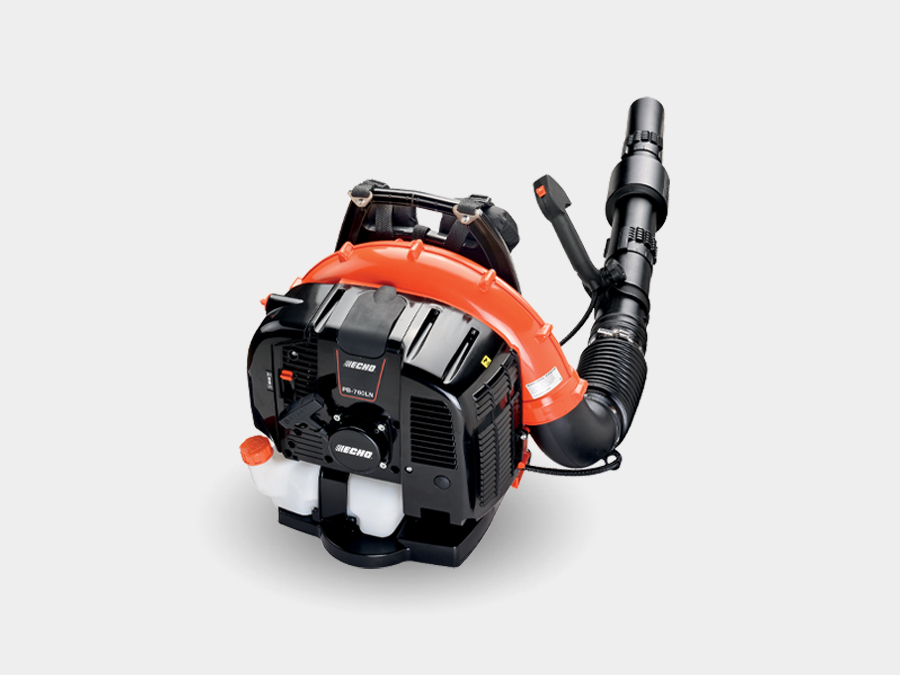
The PB-760LNT is the tube-control version of ECHO’s 63.3 cc low-noise backpack blower. ECHO describes its variable-speed control as tube-mounted, with cruise control; the PB-760LNH instead places the throttle at the operator’s hip. The choice is about where your hand changes speed while guiding the outlet. Do not read the T suffix as a different engine or higher airflow. The LNT page lists 535 CFM, and the current 2023 PB-760LN H/T operator’s manual confirms 535 CFM for the family.
Lower published sound, lower CFM than the PB-755S family
The LNT is listed at 65 dB(A) at 50 feet under ECHO’s cited standard. The manual gives the same 65 dB(A) at 50 feet. That makes it a lower-rated alternative to the PB-755ST, whose page and manual give 74 dB(A) at the same stated distance and standard. The lower rating does not mean silent operation, a measurement at the wearer’s ear, or automatic permission to work during restricted hours. ECHO still lists hearing protection in the manual, and local rules should be checked separately.
Published airflow also differs: ECHO lists 535 CFM for the 760LN and 651 CFM on the 755ST page, while the 755 manual/support table say 653 CFM. The lower figure may be a reasonable trade if sound is a firmer need than peak airflow, but CFM should not be converted into a promised number of minutes per yard. The 760LN page advertises 214 mph, the 2023 manual gives 210 mph maximum with pipes, and the current support page gives 178 mph as maximum while labeling 214 mph average. Air-speed maximum remains unsettled between the sources, so this review does not make a hard air-speed recommendation.
Tube control and maintenance demand
The T’s trigger sits at the blower tube rather than the hip. The current H/T manual describes the T’s trigger and throttle-position lever; it also gives assembly and operating instructions specific to its control layout. If you expect to make repeated adjustments while sweeping along a path, that location may suit your reach. If you would rather keep the hand on the tube simple and set speed at the hip, the LNH is the exact alternative. A product photograph can help identify the family, but this suffix should be verified by the actual model label on a prospective machine.
This remains a two-stroke gas backpack. ECHO specifies a 50:1 fuel/oil mixture, 89-octane unleaded gasoline and a 68.3-fl-oz tank; the current product page, 2023 manual and support table agree on the tank rating. The manual specifies restrictions on fuel blends, including no E-15 or E-85, and describes recoil starting with choke and purge bulb. That routine avoids battery charging, but it is not maintenance-free and it brings exhaust and fuel-handling obligations.
Use lower speed for lighter dry-leaf cleanup and only increase when material requires it, following the manual rather than relying on a maximum output claim. The manual asks for eye and hearing protection and a face-filter mask, warns against directing the tube toward people or pets, and cautions about hot surfaces. It also warns that sustained low-speed operation can create deposits, instructing the operator to run wide open for at least five minutes each hour and inspect/clean the spark arrester after about 40 hours. If those steps are not compatible with your routine, choose a different power source rather than expecting the low sound rating to change the required service plan.
Weight, model history and buying limits
Weight is not a simple reason to choose LNT over LNH. The current T page lists 26.2 lb dry with standard pipes; the current manual lists 21.6 lb dry without pipes; ECHO Support gives 23.8 lb dry without pipes. These are inconsistent official figures, and none represents a fueled, ready-to-work load. The finder therefore leaves a strict body-weight requirement unmatched for this model. The current product page directly links a 2019 PB-760LN H/T manual, while ECHO’s technical-document filter lists a later 2023 manual for the P594/P595 families. Check the actual serial and use the correct manual; a current web page alone does not establish which manual covers an older machine.
The LNT fits someone who has chosen a backpack gas blower, prefers a tube-mounted speed control, and considers the 65 dB(A) 50-foot rating more useful than the 755ST’s higher airflow numbers. Pick the PB-760LNH if the hip lever is preferable. Compare the PB-755ST when a higher published CFM rating is essential and the higher sound rating acceptable. A battery blower suits a buyer who cannot accept premix or exhaust; a vacuum/mulcher suits one who needs leaf collection rather than just moving leaves. The product is listed by ECHO in the U.S.; actual retailer stock and the serial history of a particular unit are not confirmed here.
ECHO PB-760LNT product page · ECHO PB-760LN H/T specifications · PB-760LNT technical documents · PB-760LN H/T manual for P594/P595 serial families
Key details at a glance
| Maximum published air volume | 535 CFM |
|---|---|
| Manufacturer-listed sound level at 50 ft. | 65 dB(A) |
| Batteries in this kit | 0 |
| Shoulder strap included | Yes |
| String trimmer in kit | No |
| Leaf vacuum and mulching function | No |
| Battery included in package | No |
| Charger included in package | No |
| Blower carrying style | Backpack |
| Backpack support harness | Yes |
| Power source | Gasoline |
| Engine displacement | 63.3 cm³ |
| Fuel tank volume | 2.02 L |
| Air volume at pipe | 535 CFM |
| STIHL Easy2Start | No |
| Gasoline tank capacity | 68.3 oz |
| Two-stroke fuel mixture | 50:1 gasoline and two-stroke air-cooled engine oil as specified by ECHO. |
| Manufacturer-listed weight | 26.2 lb |
| Weight measurement basis | Exact product page states 26.5 lb (LNH)/26.2 lb (LNT) dry with standard pipes; current manual states 22.0/21.6 lb dry without pipes, while support lists 24.0/23.8 lb dry without pipes. Those official values cannot be normalized into one number; a strict weight maximum stays unmatched. |
| Throttle control location | tube |
Use the exact model’s instructions for operating limits, supplied equipment and version differences.
Sources for this assessment

Match the blower to your yard and routine.
Compare the exact kit, controls, nozzle and carrying setup before choosing.