
On this page
Your needs, this model
Does it fit your priorities?
Is hip-mounted speed control essential, or could a battery backpack do the work?
ECHO places PB-7910H control at the hip; the T trigger is on the tube. The EGO LB6000 family is a battery-backpack alternative at 600 CFM, but it changes the power source and throttle arrangement. Ask a dealer to match an ECHO unit to its serial-specific manual before relying on its exact specifications.
Explore this need in the finder →If 835 CFM is enough, would you change from a gas backpack to a battery handheld?
ECHO publishes 835 CFM for the PB-7910H; EGO’s LB8803-2 is a 880 CFM battery handheld. It is a different balance and kit, not an equivalent backpack. If 880 CFM is not enough, a stricter threshold can leave no eligible match.
Explore this need in the finder →Would a lower-carrying-mass handheld be a better fit if 765 CFM is enough?
The PB-7910H page lists 26.3 lb dry, while support/manuals give full-tank weight with pipes; that is not a verified bare-tool ceiling. EGO LB7654 is a battery handheld rated at 765 CFM and 4.6 lb body weight, but the battery adds load.
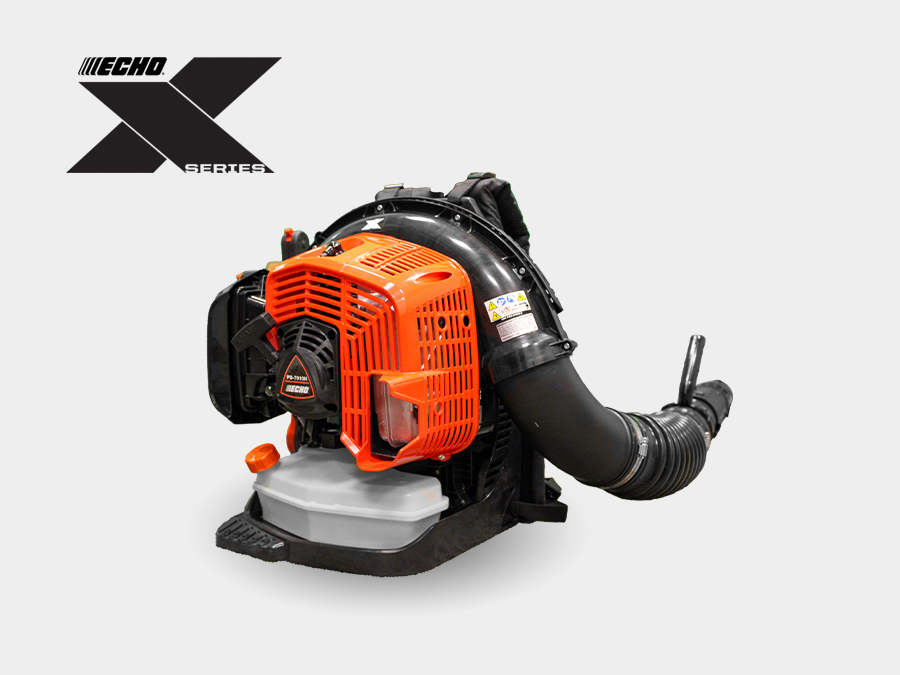
Explore this need in the finder →ECHO’s PB-7910H is a 79.9 cc gasoline backpack blower whose distinguishing feature is the hip-mounted variable-speed control. The PB-7910T uses the same published engine and air-output figures, but puts a trigger and control lever on the tube. Choose the H for that control position and its separate stick handle—not because it is the stronger version.
The hip control is the real H/T decision
ECHO lists the PB-7910H at 835 CFM, 240 mph and 40 N, and its paired PB-7910T page lists the same figures. The manual likewise gives 835 CFM, 240 mph with pipes and 40 N. Those are manufacturer specifications, not a measured cleanup time on wet leaves, packed grass or gravel. Air volume, speed and force answer different questions; your debris, surface and nozzle technique still determine whether the blower is a sensible fit.
On the H, ECHO locates variable-speed control at the hip and includes a stick handle on the swivel pipe. The T instead has a tube-mounted trigger plus a separate throttle-position lever; ECHO’s manual gives the T its own throttle-cable adjustment section. If you steer with the tube and want speed at that same hand, compare the T before settling on the H. The two control layouts are real configuration differences; neither page claims an output advantage for one.
The H’s padded straps, vented back pad, two-stage air filter, metal lower-pipe wear ring and Posi-loc pipe connections are useful design details, but they do not make the powerhead lightweight. A backpack can spread load differently from a handheld blower, yet it still needs to be lifted, strapped on, transported and stored.
Keep dry and full-tank weights separate
ECHO’s product page calls the H’s weight 26.3 lb dry. It does not state the pipe configuration beside that number. The PB-7910 H/T operator manuals and ECHO’s current support table instead list 29.5 lb with pipes and a full tank. Those are different bases, not interchangeable numbers; the full-tank measurement is not a battery-free “body weight,” and the page’s dry figure should not be entered as a known bare-tool ceiling without ECHO confirming what is included.
There is a second source difference worth resolving before comparing refueling intervals. The support table and both H/T manuals identify a 67.0 fl oz tank, while ECHO’s 2026 catalog lists 61.8 fl oz for PB-7910H/T. I would not collapse that into one exact capacity: ask ECHO or a dealer to confirm the correct serial-specific specification. The operating requirement itself is clear in the manuals: mixed gasoline and two-stroke oil at 50:1, fresh 89-octane unleaded, no methanol, and no E15 or E85. Fuel handling and mixture preparation are part of owning this machine, not optional accessories.
Plan for recoil starting, noise and maintenance
The PB-7910H uses an automatic recoil starter. The manual’s cold-start sequence calls for setting the H lever, using the choke and purge bulb, and pulling the starter; it is not a push-button start. ECHO rates the sound at 76 dB(A) under its ANSI B175.2 method at 50 feet. That test distance matters: it is not an operator-ear rating or a guarantee that neighbors will consider the machine quiet. Follow local hours and hearing-protection guidance.
ECHO says not to use the blower below 15°F (-9°C) because fuel-line damage may occur. Its manual also warns that continuous low-speed use can build fuel/oil residue and carbon on the spark-arrester screen; it calls for at least five minutes at wide-open throttle each hour and spark-arrester inspection or cleaning at roughly 40 hours. This is a large two-stroke machine with warm-up, mixed fuel, exhaust and scheduled upkeep—not a low-effort battery alternative.
Wear eye and hearing protection, use the manual’s face-filter guidance where dust warrants it, keep people and pets at least 50 feet from the work area, and do not aim debris toward windows or traffic. The product page gives a five-year consumer warranty and two-year commercial term, so its “commercial-grade” label alone is not a reason to classify the model as commercial-only.
Who should compare it—and what else to consider
Keep the PB-7910H in a comparison if you have repeated backpack-size cleanup, specifically prefer a hip-mounted speed control, and are prepared for gasoline mixing and recoil starting. It is a poor fit if your essential requirement is a documented low body-weight limit, battery-only operation, quiet use, handheld carry or vacuum collection. If the H control is not essential, the PB-7910T is the matching tube-trigger layout with the same published airflow family.
Changing operating plans changes the alternatives. EGO’s LB6000 family is a battery backpack rated at 600 CFM; it trades away the PB-7910’s gas power and higher published airflow, but removes premix and recoil starting. If a handheld form is acceptable and 880 CFM is enough, EGO’s LB8803-2 is another battery arrangement; its battery weight and balance differ from a backpack. Neither is a like-for-like replacement, and neither should be chosen by CFM alone.
The exact PB-7910H manual depends on the machine’s serial series. ECHO lists two H/T operator manuals and a quick-start guide; match the actual serial to the correct book, then ask an authorized dealer to check current safety notices and service history before relying on a used unit. The public recall-index snapshot is not a serial-specific clearance.
ECHO PB-7910H · ECHO PB-7910T · ECHO support specifications · PB-7910H technical documents · ECHO 2026 catalog
Key details at a glance
| Maximum published air volume | 835 CFM |
|---|---|
| Manufacturer-listed sound level at 50 ft. | 76 dB(A) |
| Manual-listed maximum air speed | 240 mph |
| Manual-listed maximum blowing force | 40 N |
| Batteries in this kit | 0 |
| String trimmer in kit | No |
More specifications and setup details
| Leaf vacuum and mulching function | No |
|---|---|
| Battery included in package | No |
| Charger included in package | No |
| Blower carrying style | Backpack |
| Backpack support harness | Yes |
| Power source | Gasoline |
| Engine displacement | 79.9 cm³ |
| Two-stroke fuel mixture | 50:1 gasoline/two-stroke oil; use oil meeting the operator manual ISO-L-EGD and J.A.S.O. M345-FD requirements. |
| Product-page maximum air velocity | 240 mph |
| Manufacturer-listed weight | 26.3 lb |
| Weight measurement basis | Exact product page labels 26.3 lb as dry weight but does not state pipe basis next to the number. Support and both listed H/T operator manuals specify full-tank weight with pipes of 29.5 lb. Do not substitute these bases or treat either as a verified bare-tool ceiling. |
| Throttle control location | hip |
Use the exact model’s instructions for operating limits, supplied equipment and version differences.
Sources for this assessment
- ECHO U.S. PB-7910H product page
- Official ECHO PB-7910H main product-page JPEG
- Official ECHO PB-7910H feature-callout JPEG
- ECHO official technical-document filter for PB-7910H
- ECHO PB-7910H and PB-7910T support specifications
- ECHO PB-7910 H/T Operator Manual X7501201800 (October 2023)
- ECHO PB-7910 H/T Operator Manual X7501201400 (July 2023)
- ECHO PB-7910 H/T Quick Start Guide X7151200600 (September 2023)
- ECHO 2026 Product Catalog index
- ECHO U.S. product-recall technical-document listing (reused archived snapshot)


Match the blower to your yard and routine.
Compare the exact kit, controls, nozzle and carrying setup before choosing.