
On this page
Your needs, this model
Does it fit your priorities?
Do you prefer the PB-9010T tube-mounted trigger, or could hip control or a battery backpack meet the need?
The T places its variable-speed trigger on the blower tube; the H moves the control arm to the hip. Both are reference-only while exact-unit safety/serial status is unresolved. A battery backpack changes both fuel routine and control layout; it is not an equivalent 1,110-CFM gas blower.
Explore this need in the finder →If 880 CFM is sufficient, can a battery handheld replace a gas backpack routine?
ECHO publishes 1,110 CFM for the PB-9010T, but this profile remains a technical reference and the rating is not a clearing-time guarantee. EGO LB8803-2 is a lower-output battery handheld that removes 50:1 mixing and recoil start if that format is acceptable.
Explore this need in the finder →Could a 765 CFM battery handheld be a better fit if reducing carry weight matters most?
ECHO’s page, support table and 2026 manual disagree on the PB-9010T dry weight. If the battery handheld format meets your output needs, EGO LB7654 is listed at 765 CFM and 4.6 lb for the body; it is not a fueled backpack comparison.
Explore this need in the finder →The ECHO PB-9010T is a 79.9 cc backpack blower whose defining choice is its tube-mounted throttle trigger. It shares the PB-9010H’s published airflow and fuel system, but moves speed control to the hand on the blower tube. Before treating its large CFM number as a verdict, compare the control layout, harness weight, fuel demands and the conflicting mass and tank figures in ECHO’s own documents.
The T’s trigger is the real distinction
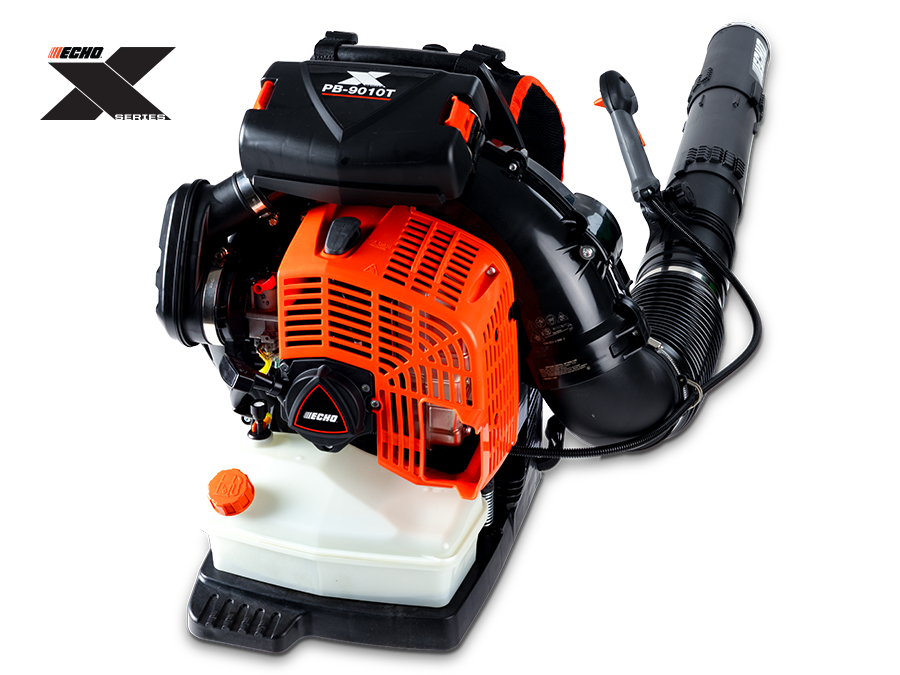
ECHO puts a variable-speed trigger on the T’s tube; the H has a hip-mounted control arm. The shared manual shows the trigger and a separate throttle-position lever: the trigger changes speed, while the lever can hold a setting for continuous use. This is a different hand arrangement, not proof that the T is more comfortable for everyone. Try the handle with the engine off and compare the H if you would rather adjust speed at the hip.
The two versions use the same 79.9 cc two-stroke engine and published output; there is no sourced performance advantage for the T over the H. ECHO lists a large pleated-paper filter with foam prefilter, vented back pad, padded straps, lower-pipe wear ring and Posi-loc pipe joints. The manual says to adjust both shoulder straps and the waist strap; check the fit against your work and body before choosing a backpack tool.
High published output has tradeoffs
ECHO rates the PB-9010T at 1,110 CFM, 220 mph maximum with pipes, and 48 N at the nozzle. The 2026 manual and support page give 31.4 m³/minute and 220 mph, but not force; 48 N remains a page-only claim, not a field result or manual-backed threshold. These are maximum specifications, not a guarantee for every wet pile, lawn or gravel driveway; ratings alone cannot establish clearing time.
Noise also merits context rather than a simple “quiet” label. ECHO’s PB-9010T product page says 80 dB(A), with a footnote to ANSI B175.2-2012. The manual and support table state 79.3 dB(A) at 50 feet under ANSI B175.2. These numbers are not measured at the operator’s ear. The manual warns that greater engine speed means more sound, instructs users to observe local hours, and calls for hearing protection; the pipe should not be pointed at people or pets.
Verify what a ready-to-work machine weighs
The official sources do not converge on a single dry mass. ECHO’s PB-9010T page lists 26.7 lb with standard pipes; the support table and October 2023 operator manual list 27.2 lb dry with pipes; the August 2026 serial-specific manual lists 27.4 lb. Those are not fueled figures, and the sources do not provide a confirmed fully fueled operating weight. The gap is large enough that I would not treat the lower page figure as a guaranteed maximum. If a weight ceiling matters, request the current serial-matched specification from ECHO or its dealer rather than assuming that “27 lb” covers the harness, fuel and accessory assembly.
Tank capacity has a related difference. The PB-9010T page and support table state 83.8 U.S. fl oz, as does the 2023 manual. The newer manual lists 87.2 fl oz for the P644/P645/P646/P647 serial ranges shown on ECHO’s documentation page. That may reflect a production revision, but the sources do not explain the change; keep it unresolved for a particular unit. The common fuel instructions are clearer: 89-octane unleaded mixed 50:1 with approved two-stroke oil, fresh fuel, and no methanol or E-15/E-85. Refueling and seasonal storage require proper handling of flammable fuel.
Starting, maintenance and restrictions are part of ownership
The PB-9010T starts with choke, purge bulb and recoil rope rather than a battery or electric start. Its manual describes the tube trigger and throttle-position lever, with a separate cable-adjustment procedure for the T handle. ECHO lists operator manuals against distinct serial ranges; the product page alone cannot tell a used-unit owner which book applies.
Both manuals state that the blower should not be operated below 15°F (-9°C) because fuel-line damage may occur; the current manual also describes a cold-weather insert and a slight performance reduction when used. Wear eye and hearing protection and the manual’s recommended face-filter mask, maintain safe bystander distance and direct exhaust away from people. Scheduled upkeep includes air-filter checks, inspection of fuel and cooling systems, cleaning cooling passages and inspection or cleaning of the spark-arrester screen. ECHO advises running at wide-open throttle for at least five minutes each hour and checking the spark arrester around 40 hours when the tool is otherwise run at extended low speed to reduce deposit buildup.
Who may prefer the tube-mounted arrangement
The PB-9010T belongs on a comparison list if you want a high-output gasoline backpack and prefer a tube trigger. It is not a light or low-maintenance option. ECHO gives it a five-year consumer warranty and two-year commercial warranty; although the marketing speaks to professional use, it is not commercial-only. If you can give up gas output, EGO’s LB8803-2 is an 880 CFM battery handheld, while the LB6000 family is a lower-output battery backpack; neither is a direct replacement.
For the H/T choice, use control placement rather than assumptions about force or CFM: H means hip-mounted throttle and T means tube trigger. ECHO’s manufacturer page, support table and serial-specific manuals do not agree on the T’s dry weight or tank capacity. The captured ECHO recall index did not contain a PB-9010 entry; absence from that index is not a no-recall guarantee. Treat this as a technical reference until a dealer verifies the exact serial, manual, current safety status and service history. Do not select a used unit from model name or photograph alone.
ECHO PB-9010T product page · ECHO PB-9010H/T support specifications · ECHO PB-9010T technical documents
Key details at a glance
| Maximum published air volume | 1110 CFM |
|---|---|
| Manufacturer-listed sound level at 50 ft. | 79.3 dB(A) |
| Manual-listed maximum air speed | 220 mph |
| Batteries in this kit | 0 |
| String trimmer in kit | No |
| Leaf vacuum and mulching function | No |
More specifications and setup details
| Battery included in package | No |
|---|---|
| Charger included in package | No |
| Blower carrying style | Backpack |
| Backpack support harness | Yes |
| Power source | Gasoline |
| Engine displacement | 79.9 cm³ |
| Two-stroke fuel mixture | 50:1 gasoline/two-stroke oil; use two-stroke air-cooled engine oil meeting ECHO manual ISO-L-EGD and J.A.S.O. M345-FD requirements. |
| Product-page maximum air velocity | 220 mph |
| Manufacturer-listed weight | 26.7 lb |
| Weight measurement basis | ECHO PB-9010T page lists 26.7 lb dry with standard pipes. Support and 10/23 operator manual give 27.2 lb dry with pipes; 08/26 serial-family manual gives 27.4 lb with pipes. Values conflict; none is fueled operating mass and generic matching weight is left unknown. |
| Throttle control location | tube |
Use the exact model’s instructions for operating limits, supplied equipment and version differences.
Sources for this assessment
- ECHO U.S. PB-9010T X-Series backpack blower product page
- Official ECHO ECHO-PB-9010T main product-page PNG
- Official ECHO ECHO-PB-9010T product-page feature callout PNG
- ECHO PB-9010H and PB-9010T support specifications
- ECHO PB-9010 H/T Operator’s Manual X7501201600 (October 2023), serial-range manual
- ECHO PB-9010 H/T Operator’s Manual X7501202901 (August 2026), later serial-range manual
- ECHO technical-document filter for PB-9010H
- ECHO technical-document filter for PB-9010T
- ECHO PB-9010 H/T Quick Start Guide X7151200501 (July 2026)
- ECHO U.S. technical documentation: product recall listing
- CPSC ECHO backpack-blower recall page: direct retrieval attempt


Match the blower to your yard and routine.
Compare the exact kit, controls, nozzle and carrying setup before choosing.