
On this page
Your needs, this model
Does it fit your priorities?
Does this family use the gasoline fuel routine rather than a battery kit?
Yes. The exact 2026 manual describes a 28 cm3 two-cycle engine and a 50:1 gasoline/oil mixture. This gasoline version remains reference-only until its exact-model recall check is accessible.
Explore this need in the finder →Must the blower also collect and mulch leaves into a bag?
The 125B does not include a vacuum kit. The 125BVx adds the bag, vacuum tubes and mulching blades, but neither is a buying match pending a recall check. The current buying-eligible EGO LV5000 and LV5005 are the verified collection alternatives in this library.
Explore this need in the finder →Is a handheld style essential, rather than a backpack harness?
Both 125-family units are handheld, not backpack blowers. Their gas-engine mass is not directly comparable with battery body-only figures unless the basis is read.
Explore this need in the finder →Can the unit’s published maximum meet a 500 CFM minimum?
No. The Husqvarna page’s 470 CFM housing figure and 425 CFM pipe figure remain below 500; available EGO models with published maxima above 500 are better matches.
Explore this need in the finder →Do I need to confirm the exact nozzle before treating the optional high-velocity attachment as included?
Yes. The US page lists round and flat nozzles, while the manual calls the 193 mph high-velocity nozzle optional for some models; do not infer that attachment from the page’s flat-nozzle label.
Explore this need in the finder →A compact gas handheld, not a vacuum package
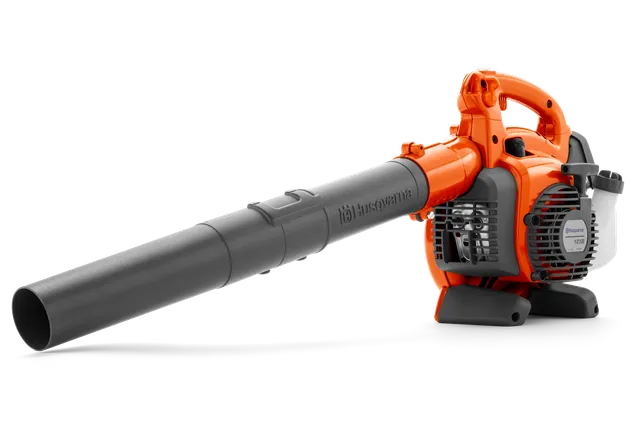
The Husqvarna 125B is a handheld, two-cycle gasoline blower. Its attraction is straightforward: a relatively light listed machine, a variable-speed trigger with cruise-control-style speed setting, and no battery system to buy. The exact US product page identifies retail SKU 952 71 19-25 and describes a 28 cm³ engine. The current support page says 9.4 lb and calls out 470 CFM; the newest operator’s manual lists 9.5 lb with blower tube and standard nozzle installed but without fuel. That small weight disagreement is retained rather than converted into a more precise promise. Neither figure includes a person’s gloves, hearing protection or fuel.
Airflow figures need more context than a single number. Husqvarna distinguishes 470 CFM in the housing from 425 CFM in the pipe. The June 2026 operator’s manual prints 12 m³/min, approximately 423 CFM, at the upper tube. The 125B page also publishes 170 mph for the flat nozzle and 130 mph for the round nozzle, while the manual lists 163 mph for its standard nozzle and up to 193 mph with a high-velocity nozzle that it describes as optional for some models. These published values are not interchangeable measurement bases; the particular nozzle and airflow location matter. The product page lists round and flat nozzle types, but that does not by itself establish that the optional high-velocity attachment is in every retail box.
Use the controls and the fuel routine as part of the fit
The tube length adjusts, the throttle is variable-speed, and the speed control can hold a chosen setting. An air-purge bulb helps clear air from the fuel system for starting; the stop switch automatically returns to its on position after use. That reset avoids leaving a simple switch in the stop position, but it is not an automatic start. The operator’s manual describes a choke, a primer bulb and a pull-start sequence, so buyers who want push-button starting or a battery tool that can be set down without managing premixed fuel should compare with an electric model instead.
This is not a four-stroke engine that takes straight gasoline. Husqvarna’s current operator’s manual specifies fresh unleaded gasoline of at least 87 AKI, ethanol below 10 percent, and a 50:1 gasoline-to-air-cooled two-cycle oil mixture. It lists a 0.5 L tank. Mixing, storing and safely handling fuel are part of ownership; the manual says not to make more than 30 days’ mixture and calls for emptying the tank before long-term storage. Read the exact manual rather than substituting a convenient fuel ratio from another tool. Regular cleaning and inspection matter too: the schedule includes the air filter and impeller, and asks for periodic checks of the spark plug, fuel lines, starter and spark-arresting screen where fitted.
Where the 125B is the cleaner choice
Choose the 125B configuration if the job is blowing debris off walks, driveways and lawn edges and you specifically want a handheld gas engine without a vacuum attachment to maintain. Its 9.5 lb manual-listed dry weight is easier to compare with other handhelds than a backpack system’s harnessed load, but that still says nothing about hand fatigue or hours of use. The manual describes occasional operation and reports 11.5 m/s² equivalent vibration at the handles, so treating a low machine weight as permission for long uninterrupted sessions would be a mistake.
Husqvarna’s current page lists 12.5 N maximum blow force. The manual does not provide that same force figure in its technical table, so this assessment attributes it to the product/support page rather than calling it a manual measurement. A force or CFM maximum helps screen candidates; it does not predict how quickly a particular pile will move in damp grass, around shrubs or across a windy driveway. Use controlled sweeps and gather leaves where they can be collected instead of trying to solve every cleanup by holding maximum throttle.
What changes if collection matters
The closely related 125BVx is the family alternative when you need an actual blower-vacuum-mulcher, bag and vacuum tubes. It shares the same nominal 28 cm³ platform and blower-mode output, but it is slightly heavier in the current manual and adds a separate collection setup. The 125B has no vacuum kit. If vacuum collection is an essential need, do not let the shared 125 name or matching orange housing blur that difference. A battery vacuum may be a better fit if you want to avoid fuel mixing, and a stronger blower may be preferable if moving large volumes is more important than bagging them.
Before purchasing, verify the exact SKU and check current CPSC and manufacturer safety notices; a product listing is not a recall clearance. Wear the manual-required eye and hearing protection, use the 50 ft bystander distance, and never run a gasoline engine in a space without adequate airflow.
Official source trail
This assessment uses Husqvarna’s US 125B product page, its US product support/specification page and the shared 125B/125BVX operator’s manual.
Key details at a glance
| Maximum published air volume | 470 CFM |
|---|---|
| Manufacturer-listed sound level at 50 ft. | {'blower': 92.6} dB(A) |
| Manual-listed maximum air speed | 163 mph |
| Manual-listed maximum blowing force | 12.5 N |
| Manufacturer-listed tool weight (check basis) | 9.5 lb |
| Batteries in this kit | 0 |
More specifications and setup details
| Nozzles in the kit | round / flat |
|---|---|
| Shoulder strap included | No |
| String trimmer in kit | No |
| Leaf vacuum and mulching function | No |
| Battery included in package | No |
| Charger included in package | No |
| Blower carrying style | Handheld |
| Backpack support harness | No |
| Package charger class | Not included |
| Fuel gauge on included battery | No |
| Power source | Gasoline |
| Engine displacement | 28 cm³ |
| Engine output | 1.1 hp |
| Fuel tank volume | 0.5 L |
| Air volume at pipe | 425 CFM |
| Manual-listed air volume at upper tube | 423 CFM |
| Two-stroke fuel mixture | 50:1 gasoline to air-cooled two-cycle oil; manual specifies 87 AKI minimum and less than 10% ethanol |
| Weight measurement basis | 2026 operator manual: without fuel, with blower tube and standard nozzle fitted; current support page differs by 0.1 lb (9.4 vs 9.5 for 125B; 9.6 vs 9.7 for 125BVx). No full vacuum-mode weight is published. |
Use the exact model’s instructions for operating limits, supplied equipment and version differences.
Sources for this assessment
Match the blower to your yard and routine.
Compare the exact kit, controls, nozzle and carrying setup before choosing.