
Your needs, this model
Does it fit your priorities?
If gasoline is not essential, does a battery backpack with at least 600 CFM meet the same backpack-format need?
The current battery library has the EGO LB6002 backpack kit at 600 CFM. It is not the 150BT gas engine or a like-for-like field test; it is a purchase-eligible alternative only when battery power is acceptable.
Explore this need in the finder →Does the 150BT clear a 480-CFM outlet-flow requirement when housing airflow is kept separate?
No. The product/support page gives 452.03 CFM in the pipe; 765 CFM is the housing figure. A 480-CFM floor is not met by that outlet figure.
Explore this need in the finder →Can I set a hard 15-lb blower-body ceiling before fuel and keep the 150BT in the shortlist?
No. The June 2026 manual lists 22 lb without fuel (the support page gives 21.95 lb). It exceeds 15 lb before the carried fuel is added.
Explore this need in the finder →What the 150BT does—and which airflow figure belongs to the job
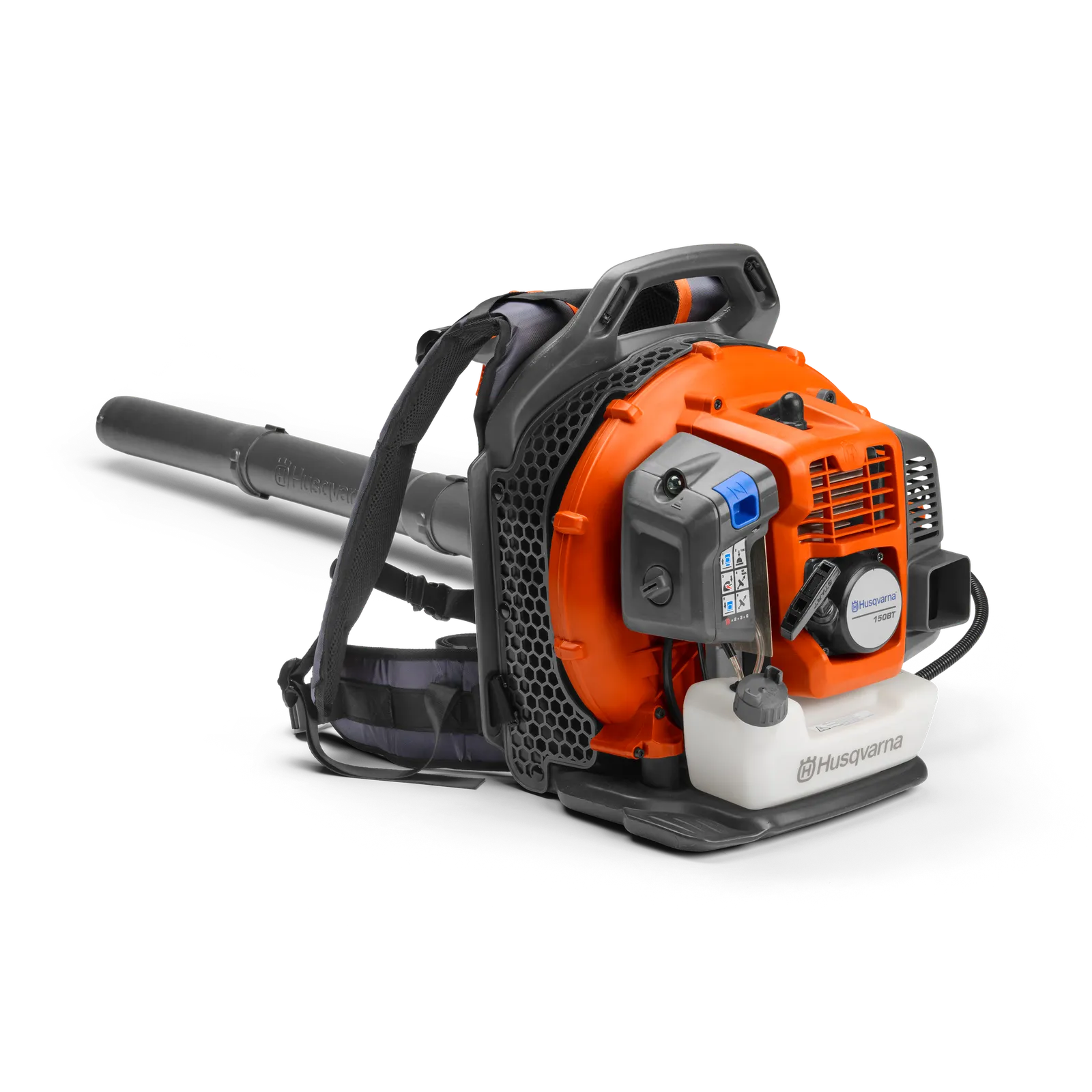
Husqvarna’s 150BT is a fuel-engine backpack blower for a homeowner who deliberately wants the gas routine: fill a two-cycle mix, pull-start, and carry the engine on an integrated harness rather than hold it in one hand. The US product listing identifies article 970 46 69-01 and an included round nozzle. The current operator’s manual calls the model 150BT Mark II (BP152HV). This review is about that exact 150BT configuration, not the older 150BT generations sold under other article numbers.
The specification that first catches the eye is 270 mph. Husqvarna’s product page labels 270 mph as the maximum air speed at the round nozzle, while its support table separately shows 765 CFM in the housing and 452.03 CFM in the pipe. That distinction matters: the large 765 number describes air inside the blower housing, not the flow at the tube outlet. For the same reason, a 270-mph velocity number cannot by itself establish that the 150BT moves more air volume than a model with a lower advertised speed.
The June 2026 manual lists 270 mph with the high-speed nozzle and 765 CFM in the housing; it does not provide an outlet CFM in its technical-data table. The product page reports 452.03 CFM in the pipe and shows 270 mph for the round nozzle. The manufacturer labels are therefore not a single, fully aligned test basis. For the finder’s minimum-volume comparison, this review uses the support page’s 452.03 CFM pipe figure rather than the housing figure. If a particular nozzle attachment is essential, check the exact package: the manual’s component diagram names a high-speed nozzle, while the online package summary calls out a round nozzle.
A three-model choice, not a contest of headline numbers
The 150BT sits between two other Husqvarna gas backpacks in the reviewed family. The 350BT’s manufacturer page lists 494.41 CFM at the pipe and 21 N maximum force; the 150BT lists 452.03 CFM at the pipe and 22 N. Thus, the 150BT has a slightly higher published force and a much higher labeled velocity, but the 350BT has the higher pipe-flow specification. The 360BT moves into another class: 30 N, 631 CFM at the pipe on the product page, and a 65.6 cc engine. These figures answer different questions. If your must-have is a firm 500-CFM nozzle-flow floor, the 150BT misses it; a household willing to move to a larger and heavier machine can study the 360BT instead. These are manufacturer maxima, not a measured clearing rate on a specific pile.
Carrying weight is another useful filter. The 2026 manual gives 22.0 lb without fuel, while the live support page lists 21.95 lb. Those are close rounded values, not a complete fueled operating weight. The 1.25-L manual tank adds weight as fuel is carried, and the backpack’s harness does not make that load disappear. The product page describes padded straps, a hip belt and weight-leveling support; the practical gain is distributing a heavy assembly, not turning it into a light blower.
Starting and owning it is part of the purchase
The 150BT uses a 51.7 cc two-stroke engine and requires a 50:1 gasoline-to-air-cooled-two-stroke-oil mixture. Husqvarna’s manual specifies at least 87 AKI gasoline and no more than 10% ethanol. The air-purge bulb helps move fuel through the system before starting, and the adjustable throttle has a cruise-control option for holding a chosen speed. Those features streamline steps; they do not remove the need to keep fresh, correctly mixed fuel, clean the air filter, inspect the spark plug, and follow the manual’s storage and service procedure.
Noise deserves equal weight in a household decision. The current support page lists 110 dB(A) at the operator’s ear, plus 110 dB(A) measured sound power and 113 dB(A) guaranteed sound power. These are manufacturer declarations, not measurements made for this review; the different sound metrics should not be compared as if they shared one microphone position. The manual calls for approved hearing and eye protection and says to stop if people or animals come within 15 m. A compact lot with close neighbors, narrow work hours or a strong preference for low-noise operation is a poor fit regardless of the 270-mph label.
Who should consider a different plan?
On paper, the 150BT suits a homeowner who wants a backpack layout, variable airflow, a round nozzle and a strong fast stream, and is prepared for fuel mixing, pull starting and engine upkeep. It does not vacuum or mulch leaves, and the reviewed manufacturer pages provide no complete carried weight with fuel. If backpack carry matters but you want a non-gas routine, the EGO LB6002 is a documented battery-backpack alternative in this library; its power source and package differ, and its published output should be considered on its own terms. If hand-held carry is acceptable and two batteries in the same box matter, compare the EGO LB8803-2 instead. Neither is a like-for-like gas replacement.
This assessment is reference-only, not a purchase recommendation. An exact-model CPSC safety determination for article 970 46 69-01 was not established in the recorded official-source check, so no recall or no-recall claim is made. A current manufacturer listing and a technical fit do not resolve that question. The 150BT remains excluded from buying matches until its exact-model status can be established.
Official sources and version boundary
Facts were checked against Husqvarna’s US 150BT product page, US support/specification page, and the June 2026 150BT Mark II operator’s manual. Page and manual labels differ for airflow and how the high-speed nozzle is described; those bases are preserved above rather than blended.
Key details at a glance
| Maximum published air volume | 452.03 CFM |
|---|---|
| Manufacturer-listed sound level at 50 ft. | 110 dB(A) |
| Manual-listed maximum air speed | 270 mph |
| Manual-listed maximum blowing force | 22 N |
| Manufacturer-listed tool weight (check basis) | 22 lb |
| Batteries in this kit | 0 |
| Nozzles in the kit | round |
| Shoulder strap included | No |
| String trimmer in kit | No |
| Leaf vacuum and mulching function | No |
| Battery included in package | No |
| Charger included in package | No |
| Blower carrying style | Backpack |
| Backpack support harness | Yes |
| Package charger class | Not included |
| Power source | Gasoline |
| Engine displacement | 51.7 cm³ |
| Engine output | 2.16 hp |
| Fuel tank volume | 1.25 L |
| Air volume at pipe | 452.03 CFM |
| Two-stroke fuel mixture | 50:1 gasoline to air-cooled two-stroke oil; at least 87 AKI and no more than 10% ethanol, per exact current operator manual. |
| Weight measurement basis | Manual: 22.0 lb without fuel; product/support page: 21.95 lb. Neither is complete fueled operating weight. |
Use the exact model’s instructions for operating limits, supplied equipment and version differences.
Sources for this assessment
- Husqvarna US 150BT exact product page, article 970 46 69-01
- Husqvarna US 150BT support, manuals and current specifications
- Husqvarna 150BT Mark II operator manual, June 2026
- CPSC exact-model search for Husqvarna 150BT; safety determination not established
- Husqvarna US residential-leaf-blower directory; 150BT observed row
Match the blower to your yard and routine.
Compare the exact kit, controls, nozzle and carrying setup before choosing.