
Your needs, this model
Does it fit your priorities?
If backpack carry and battery power are both essential, is there a current alternative meeting a 600-CFM floor?
The EGO LB6002 is a documented battery-backpack kit with a 600-CFM published maximum. This changes from gasoline to battery rather than copying the 350BT’s engine plan.
Explore this need in the finder →Does the 350BT meet a 495-CFM nozzle/pipe floor?
No. Its exact support page gives 494.41 CFM at the pipe; the manual rounds to 494. The 495-CFM threshold is just above the published number.
Explore this need in the finder →Could a battery backpack that weighs no more than 15 lb before its battery remain an alternative?
The EGO LB6002 facts show a 12.5-lb blower body before its included battery, while the 350BT is 22.5 lb without fuel. This is an equipment-format change, not equal mass after the full operating configuration is assembled.
Explore this need in the finder →The middle-output option in Husqvarna’s gas-backpack family
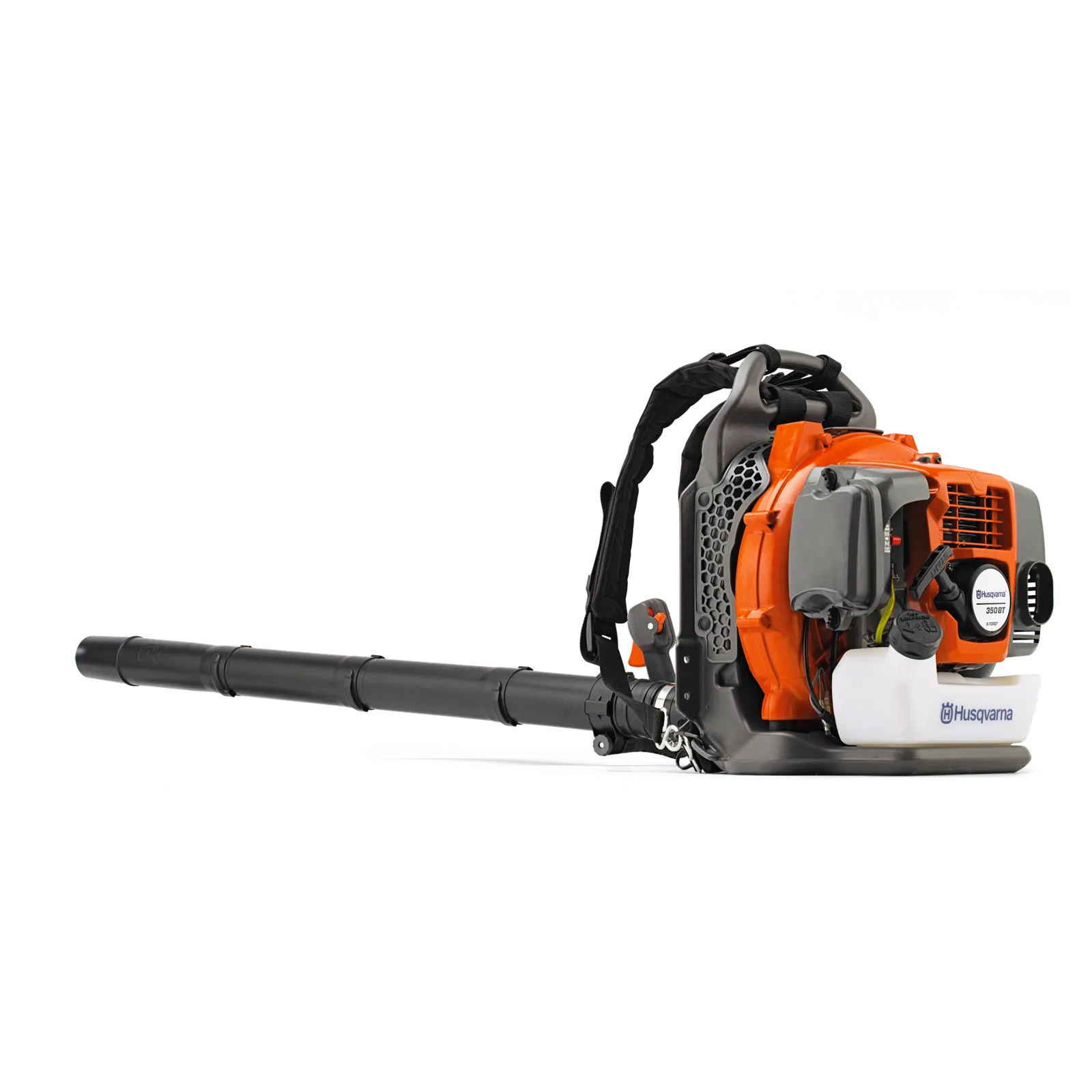
The Husqvarna 350BT is a gas backpack blower for buyers who value continuous work away from an outlet and accept the associated engine routine. The current US page identifies article 965 87 75-02, a round nozzle, an integrated harness and no vacuum kit. The operator carries the engine on the frame and guides the tube with the control handle; it is not a handheld blower, a battery backpack, or the related 350BF. Husqvarna’s May 2024 operator manual covers both 350BT and 350BF, but those are separately named configurations. The facts here use the BT column and current BT product page only.
Its defining performance point is not the highest nozzle velocity in this family but a middle position in the airflow and force figures. Husqvarna lists 50.2 cc, 2.1 hp, 21 N, 494.41 CFM at the pipe and 180.01 mph at the round nozzle. The manual rounds those last two output figures to 494 CFM and 180 mph with the blower nozzle. It also gives 22.5 lb without fuel and a 1.25-L tank. On the manufacturer’s published values, the 350BT moves more air at the pipe than the 150BT’s 452.03 CFM, while its peak force is 21 N rather than 22 N and its listed maximum velocity is lower. If the question is “will the 350BT meet a 500-CFM minimum?” the answer is no: 494.41 is close, but still below that threshold.
Control and vibration details matter over repeated passes
Husqvarna lists an adjustable offset handle, a padded harness with hip belt and weight-leveling support, LowVib dampers, air purge and a variable throttle with a cruise-control option. The practical plan is to set a speed that moves the material, then use the control arrangement rather than running at maximum for every pass. The manual advises choosing the lowest throttle setting that works to avoid unnecessary noise and dust. The 360BT offers more air and force, but the 350BT may be the more proportionate reference for a homeowner who does not need a 30-N tool.
The support page gives 94 dB(A) sound pressure at the operator’s ear and 104 dB(A) for both measured and guaranteed sound power. Those are distinct manufacturer-declared metrics, not a single noise level or an independent test here. The operator-ear value is lower than the 150BT and 360BT support-page values, but it does not make this a quiet machine or a substitute for hearing protection. The manual includes protective-equipment guidance, a 15-m safety distance from people and animals, and warnings about exhaust and hot surfaces. Local noise rules and nearby occupants still matter.
Fuel, weight and the setup it cannot do
Like the other two BT models in this comparison, the 350BT has a two-cycle engine. Its manual specifies a 50:1 gasoline and air-cooled two-stroke-oil mix, 87 AKI minimum fuel and no more than 10% ethanol. The tank holds 1.25 L; Husqvarna says to mix only what is needed for up to one month and to keep the fuel accurately measured. Air purge reduces the need to prime the carburetor manually, but the machine still requires pull starting, fresh mixed fuel, spark-plug and filter attention, and seasonal storage work.
At 22.5 lb without fuel, the 350BT is already a substantial carried package. The product page and manual agree on the dry-weight figure; neither supplies a full working mass with fuel. Backpack straps distribute load over the torso, but anyone with a strict total carrying-weight ceiling should not treat the published dry number as fueled weight. The 350BT is a dedicated blower: the exact page says no vacuum kit, and the manual does not describe a leaf collection or mulching setup. Choose a blower-only plan only if blowing leaves into manageable piles is the goal.
How questionnaire choices change its fit
A backpack requirement and round nozzle fit the listed configuration. A 480-CFM minimum is met by the manufacturer’s 494.41-CFM pipe figure; a 495- or 500-CFM minimum is not. A 20-lb maximum before fuel excludes it, and requiring battery power excludes all three gas backpacks. A vacuum-and-bag requirement also excludes it. Those distinctions are more useful than calling it a general “powerful” option: the 350BT’s actual point is a 50-cc backpack with moderate volume, not a machine that simultaneously meets every demand.
If you want backpack carrying without fuel mixing, the EGO LB6002 is a documented battery-backpack kit in this library, but it uses a battery system and does not share the 350BT’s engine, output labels or gas operating plan. If the objective is substantially higher airflow and the backpack is not essential, consider the EGO LB8803-2 as a distinct handheld kit; it has a different package and no shoulder harness. These are alternatives for different needs, not proof that the machines have equal field performance.
This review is reference-only. Husqvarna’s current US product and support pages list the 350BT, but the exact-model CPSC safety determination for article 965 87 75-02 was not established in the recorded official-source check. No recall or no-recall statement is made, and the model is not included in purchase matching while that status remains unresolved.
Official sources and exact model
The assessment uses Husqvarna’s US 350BT product page, US support/specification page, and the May 2024 350BT/350BF operator’s manual. Output values are stated at the blower nozzle or pipe, not as housing flow; 350BF figures and controls are not substituted for the reviewed BT SKU.
Key details at a glance
| Maximum published air volume | 494.41 CFM |
|---|---|
| Manufacturer-listed sound level at 50 ft. | 94 dB(A) |
| Manual-listed maximum air speed | 180.01 mph |
| Manual-listed maximum blowing force | 21 N |
| Manufacturer-listed tool weight (check basis) | 22.5 lb |
| Batteries in this kit | 0 |
| Nozzles in the kit | round |
| Shoulder strap included | No |
| String trimmer in kit | No |
| Leaf vacuum and mulching function | No |
| Battery included in package | No |
| Charger included in package | No |
| Blower carrying style | Backpack |
| Backpack support harness | Yes |
| Package charger class | Not included |
| Power source | Gasoline |
| Engine displacement | 50.2 cm³ |
| Engine output | 2.1 hp |
| Fuel tank volume | 1.25 L |
| Air volume at pipe | 494.41 CFM |
| Two-stroke fuel mixture | 50:1 gasoline to air-cooled two-stroke oil; at least 87 AKI and no more than 10% ethanol, per exact current operator manual. |
| Weight measurement basis | Manual table’s BT column: 22.5 lb without fuel; current support page lists the same weight. No total with fuel is published. |
Use the exact model’s instructions for operating limits, supplied equipment and version differences.
Sources for this assessment
- Husqvarna US 350BT exact product page, article 965 87 75-02
- Husqvarna US 350BT support, manuals and current specifications
- Husqvarna 350BT/350BF operator manual, May 2024, English section
- CPSC exact-model search for Husqvarna 350BT; safety determination not established
- Husqvarna US residential-leaf-blower directory; 350BT observed row
Match the blower to your yard and routine.
Compare the exact kit, controls, nozzle and carrying setup before choosing.