
Your needs, this model
Does it fit your priorities?
If you prefer tube-mounted control but the gas backpack is too much, what battery backpack alternative reaches 600 CFM?
The 580BTS Mark III has a right-hand variable-speed throttle on the tube and a cruise-control option. If battery power is acceptable instead, the EGO LB6000 is a separate 600 CFM battery backpack body-only plan; its pack and charger are not included and its performance is not equivalent.
Explore this need in the finder →If you need bagged collection rather than the 580BTS blower-only setup, what reviewed tool has a 40 L bag?
The 580BTS moves air but has no vacuum or mulch mode. The EGO LV5000 and LV5005 are separate blower/vacuum/mulcher configurations with a listed 40 L collection bag; collection uses its own assembly.
Explore this need in the finder →If handheld battery power matters more than the 580BTS backpack, which reviewed body reaches 30 N under 5 lb?
The EGO LB8803-2 is a separate battery handheld listed at 30 N and 4.9 lb bare-tool weight. It does not duplicate the 580BTS backpack or its 47 N published maximum.
Explore this need in the finder →A 580-series backpack for large, demanding clearing jobs
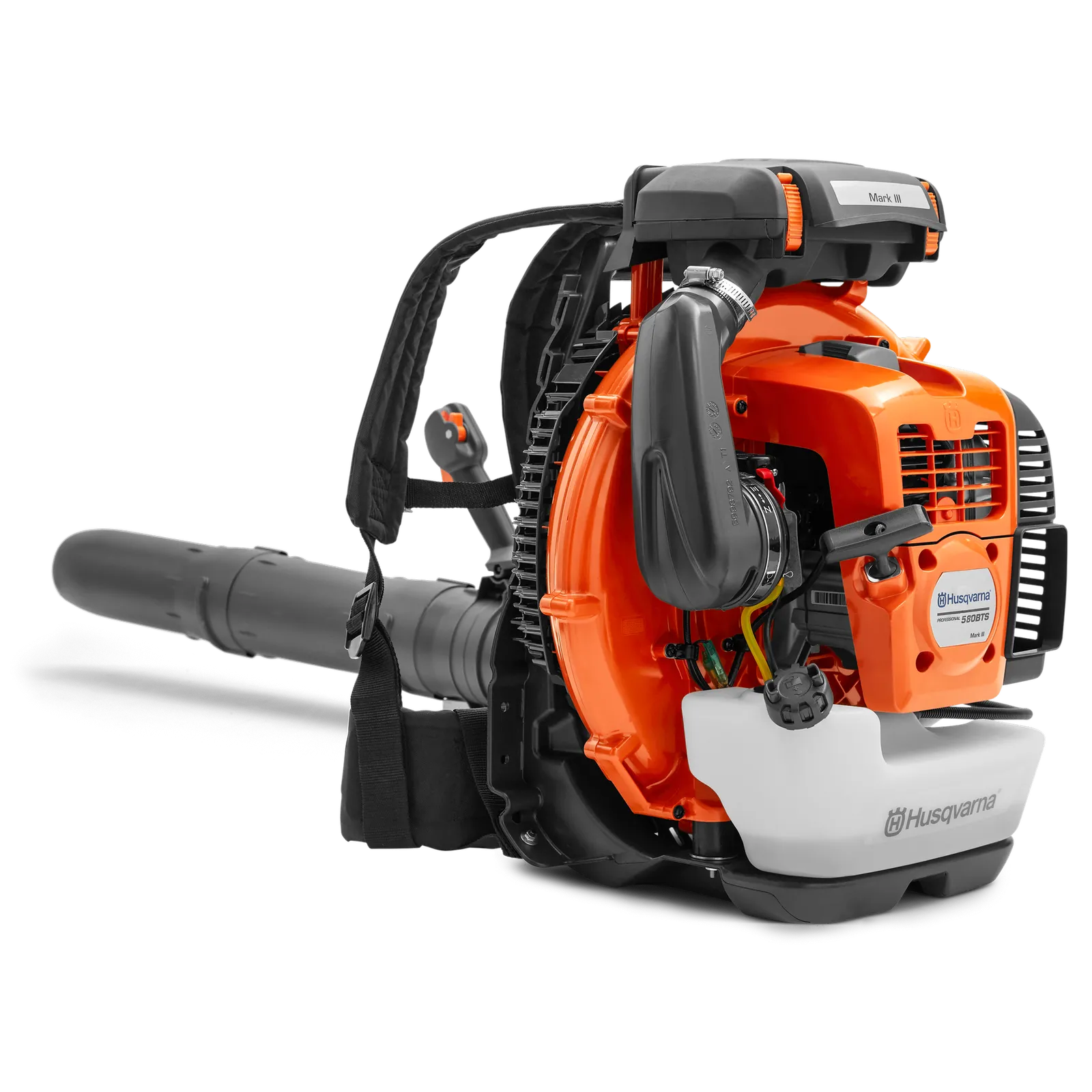
The current U.S. Husqvarna 580BTS Mark III is a substantial gasoline backpack blower, not a light tool for an occasional stoop. The product page identifies the North American right-hand-throttle model as article 970 49 91-01. It lists a 75.6 cc two-stroke engine, 47 N maximum blowing force, 1,000 CFM of air flow at the round nozzle, and a 220 mph maximum with that nozzle. The 2025-02 operator’s manual gives the same fan figures. They describe manufacturer-rated maximums, not independent test results or a promise that a particular yard clears in a set time.
This output is most relevant when a lot of ground must be moved in repeated passes, or when ordinary lawn clippings and leaf piles are a recurring workload. A powerful stream can help consolidate debris, but it does not make wet leaves disappear, turn grass into a collection bag, or reduce the time needed to rake and haul what is gathered. A 2.6 L tank is a capacity figure, not an operating-time estimate. Wind, debris condition, how long the trigger is held, and the operator’s route all change fuel use and cleanup time.
Why choose BTS rather than the 580BFS?
The useful family distinction is control placement, not a different fan rating. Husqvarna describes the 580BTS as a right-hand throttle at the blower tube. Its variable-speed control has a cruise-control option. The sister 580BFS puts a left-hand throttle on the backpack frame. Both current Mark III products have the same 75.6 cc displacement, integrated harness, round nozzle, 47 N listed force, 1,000 CFM at the nozzle, and 220 mph standard-nozzle speed. The current pages and shared manual list the BTS at 26.8 lb and the BFS at 27.1 lb; the product FAQs explicitly describe both weights as before fuel. That small difference does not make the BTS a meaningfully lighter class of machine.
The tube-mounted BTS layout suits an operator who prefers the throttle alongside the hand guiding the air tube. The BFS frame location is the alternative for someone who prefers that arrangement. These are layout choices, not proven differences in comfort, safety or clearing speed. If the control location is essential, inspect the exact model and handle before buying; do not assume the shared engine makes the handles interchangeable. Both pages list an integrated harness and a round nozzle. Neither configuration includes a vacuum kit or turns leaves into mulch.
Fuel, noise and setup are part of the machine
This is a recoil-started two-stroke blower with a mixed-fuel routine. Its 2025 manual specifies a 50:1 gasoline-to-air-cooled two-stroke-oil blend, fresh unleaded gasoline rated at least 87 AKI, and less than 10% ethanol; do not prepare more than a 30-day quantity of mixed fuel. The tank holds 2.6 L (87.92 U.S. fl oz). The manual’s cold-start instructions use the choke, air-purge bulb, throttle position and pull starter. That routine and the need to handle fuel safely are real ownership requirements, not optional details hidden behind the airflow number.
Maintenance also continues after the first cleanup: the manual calls for checking the air-intake screen, cleaning the filter and inspecting the machine at the stated intervals. It warns that a blocked intake reduces blow force and raises engine temperature. The current product page lists 106 dB(A) sound pressure at the operator’s ear; Husqvarna’s manual requires hearing and eye protection and keeps other people and animals at least 15 m away. Do not run the engine indoors, and allow it to cool before refueling. These constraints make the BTS a poor fit where low noise, no exhaust, quick grab-and-go use or neighborhood restrictions dominate.
Where it fits—and where it does not
Consider the 580BTS if your work genuinely benefits from a backpack, high published airflow and force, right-hand tube control, and a large gas tank—and if you accept the mixed-fuel, recoil-start, maintenance, noise and protective-equipment routine. Its manufacturer-listed bare weight is 26.8 lb before fuel; full working weight with fuel is greater, and the reviewed materials do not give that complete figure. The harness carries the machine, but does not make it lightweight.
If gasoline is not essential, the EGO LB6000 is a different, lower-output battery backpack body-only plan; its compatible battery and charger are not included. For a handheld arrangement, the EGO LB8803-2 is a separate 30 N battery option, not a substitute with the same carrying style or gas output. If you want leaves collected in a bag, the EGO LV5005 review covers a vacuum/mulcher package with a separate collection assembly. The 580BTS is blower-only, so a nozzle change cannot add that function.
This assessment covers the current North American 580BTS Mark III SKU. Husqvarna’s support area also shows older 966-series records with different output numbers; those values are not interchangeable with the current page’s 970 49 91-01 configuration. This profile is a technical comparison, not a purchase recommendation: exact-model safety eligibility has not been established here. That is not a finding that the model has been recalled or cleared. Verify the exact SKU, manual and applicable safety status before relying on an older listing or machine.
Manufacturer source trail
Identity, package contents, controls and current published figures were checked against the Husqvarna U.S. 580BTS product page for article 970 49 91-01 and its support page. Setup, fuel, safety and technical data were checked in the 2025-02 operator’s manual for 580BTS Mark III and 580BFS Mark III, revision 1667-004.
Key details at a glance
| Maximum published air volume | 1000 CFM |
|---|---|
| Manufacturer-listed sound level at 50 ft. | 106 dB(A) |
| Manual-listed maximum air speed | 220 mph |
| Manual-listed maximum blowing force | 47 N |
| Manufacturer-listed tool weight (check basis) | 26.8 lb |
| Batteries in this kit | 0 |
| Nozzles in the kit | round |
| String trimmer in kit | No |
| Leaf vacuum and mulching function | No |
| Battery included in package | No |
| Charger included in package | No |
| Blower carrying style | Backpack |
| Backpack support harness | Yes |
| Package charger class | Not included |
| Power source | Gasoline |
| Engine displacement | 75.6 cm³ |
| Engine output | 4.6 hp |
| Fuel tank volume | 2.6 L |
| Air volume at pipe | 1000 CFM |
| Gasoline tank capacity | 87.92 oz |
| Two-stroke fuel mixture | Current linked 2025-02 operator manual: 50:1 unleaded gasoline to air-cooled two-stroke oil, minimum 87 AKI, less than 10% ethanol, no more than 30 days of premix. For BTS, product FAQ additionally recommends non-ethanol premium fuel and says “minimum 89 octane” without specifying AKI/RON; retain this wording conflict. |
| Product-page maximum air velocity | 220 mph |
| Manufacturer-listed weight | 26.8 lb |
| Weight measurement basis | Current exact product-page FAQ says 26.8 lb without fuel. The current manual technical table lists the same figure but only labels the row Weight. Full fuel-ready operating weight is not published in sources reviewed. |
| Throttle control location | tube |
Use the exact model’s instructions for operating limits, supplied equipment and version differences.
Sources for this assessment
- Husqvarna U.S. exact current 580BTS Mark III product page, article 970 49 91-01
- Husqvarna U.S. 580BTS support page (older support-SKU table separately noted)
- Husqvarna official 580BTS Mark III / 580BFS Mark III operator manual, published 2025-02, revision 1667-004
- Husqvarna official 580BTS Mark III studio-format WebP product image

Match the blower to your yard and routine.
Compare the exact kit, controls, nozzle and carrying setup before choosing.