
On this page
Your needs, this model
Does it fit your priorities?
If I prefer the 590BTS tube-mounted control but need a verified lighter 30 N handheld, what changes?
The 590BTS is a 56 N gas backpack with a right-hand tube throttle; its published 26.2 lb weight has no stated fuel basis and it remains reference-only. If handheld carry and battery power are acceptable, EGO LB8803-2 is a separate 30 N, 4.9 lb body alternative—not a backpack equivalent.
Explore this need in the finder →If a one-tool leaf vacuum and mulcher matter more than the 590BTS blower-only configuration, what package can meet that collection need?
The Husqvarna 590BTS has no vacuum or bag mode. EGO LV5000 and LV5005 are separately assessed leaf-vacuum/mulcher configurations; blower and vacuum use separate assemblies, not one simultaneous mode.
Explore this need in the finder →If I want a lighter battery backpack alternative rather than the 590BTS gas engine, which tool-only option meets a 600 CFM floor?
EGO LB6000 is a 600 CFM battery backpack body-only configuration. Its published output and carrying style are not the 590BTS 56 N gas plan; each is a distinct power system.
Explore this need in the finder →When a very high-output backpack blower is the actual requirement
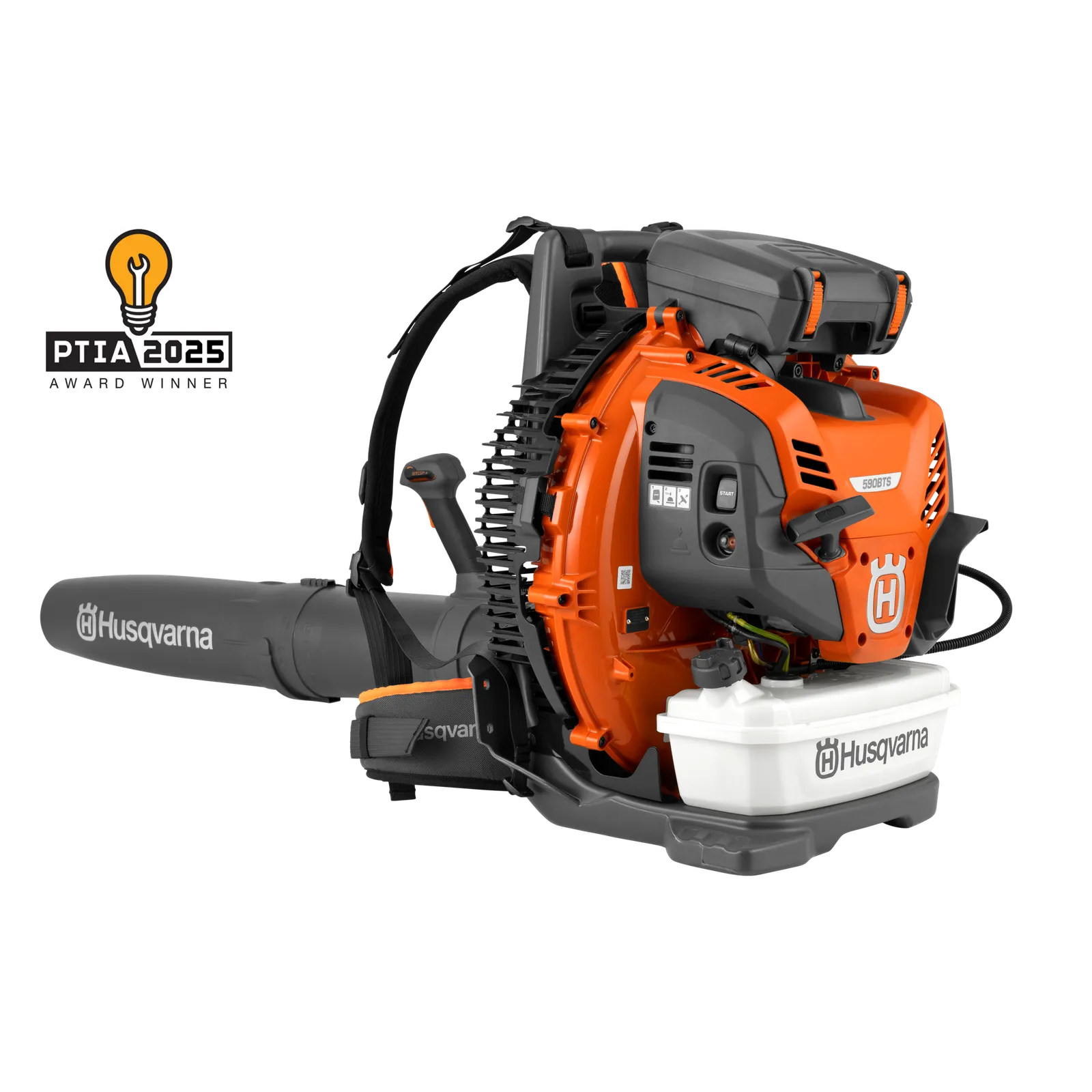
The Husqvarna 590BTS is a large gas backpack blower for sustained, heavy clearing rather than a light tool for occasional patio cleanup. The current U.S. product page identifies article 970 55 10-02 and lists a 79.4 cc two-stroke engine, a round nozzle, an integrated harness, 56 N maximum blow force and 26.2 lb manufacturer-listed weight; the manual and product-page table do not state whether this figure includes fuel. Husqvarna’s 2024-04 operator’s manual lists 1,245 CFM and 216 mph with the standard nozzle. These are manufacturer specifications, not measurements made for this review, and the nozzle figures describe one blower configuration rather than guaranteed yard-clearing speed.
The case for the 590BTS is the combination of airflow and force. That matters more when the work involves broad, deep accumulations or heavy debris than when you are simply tidying a small walkway. The 2.7 L (91.3 fl oz) tank is large, but neither tank size nor a maximum airflow rating establishes how long a particular job will take. Wetness, surface, wind, nozzle control and the operator’s pace all change what the stream can move. If your normal job is a few short passes around a house, its size, fuel routine and carrying weight may be more burden than benefit.
The tube control is the meaningful choice in the 590 pair
On the 590BTS, the variable-speed throttle is mounted on the blower tube at the right-hand handle. Husqvarna lists a cruise-control option. Its sister model, the 590BFS, places its control on the left side of the backpack frame. The manufacturer gives both models the same 79.4 cc displacement, 56 N force, 1,245 CFM nozzle airflow, 216 mph standard-nozzle speed and 2.7 L tank. The BTS is listed at 26.2 lb and the BFS at 26.7 lb. The shared manual labels the table simply “weight” and does not state a fuel basis, so neither number should be treated as a verified ready-to-work total or a confirmed empty-tank tool weight. That half-pound difference and throttle location—not a higher output rating—are the useful comparison points.
Choose the BTS if you want to vary speed at the right-hand tube while directing the nozzle. Choose the BFS if a frame-mounted control is the preference. Neither arrangement changes the published maximum airflow or force. The manual treats assembly of the BTS throttle cable along the tube as part of putting the unit together, so careful setup matters; follow its routing and clamping steps rather than improvising. The included round nozzle and backpack harness are part of the documented operating configuration. The product page lists no vacuum kit: this is a blower, not a leaf-collection or mulching combination.
Fuel and protection are part of the ownership decision
The manual specifies a 50:1 gasoline-to-two-stroke-oil mixture, at least 87 AKI gasoline and no more than 10% ethanol. It also says not to make more than a 30-day quantity of mixed fuel. Mixing accurately, storing fuel safely, cleaning the air intake and filter, and servicing a gasoline engine are recurring ownership tasks. The start routine uses the air-purge bulb, the start button and a pull starter. The button is not an electric motor starter, and it does not remove the need for the recoil-start procedure.
The manufacturer-listed weight is 26.2 lb, but the reviewed sources do not specify whether it includes fuel. The 2.7 L tank changes the carried mass as fuel is added; a complete ready-to-work weight is not published, so neither a bare-tool ceiling nor a maximum total weight can be verified from that figure alone. Husqvarna describes a padded harness and waist belt, and the manual explains adjusting the shoulder, chest, waist and load-lifter straps. Those features help configure the carry system; they do not make the blower light. The manual calls for hearing and eye protection and a 15 m separation from people and animals. If low noise, minimal setup, or a light one-handed tool is essential, look at a battery handheld plan instead of trying to make this backpack fit.
How the practical questions change the fit
A gas, backpack, round-nozzle requirement fits the documented 590BTS operating plan, but the exact profile remains reference-only. A 56 N minimum is listed on the manufacturer’s page. A hard 25 lb bare-body ceiling cannot be verified: the 26.2 lb weight has no stated fuel basis, and the sources do not establish a bare-tool value. A requirement for a bag, vacuuming or mulching also fails because this model is blower-only. If a 30 N battery handheld is a better compromise than a 26.2 lb gas backpack, the reviewed EGO LB8803-2 is a different operating plan to compare; it is not an equivalent backpack machine. If collecting leaves is essential, the EGO LV5005 review covers a separate battery vacuum/mulcher plan instead.
This 590BTS assessment is for comparison, not a current purchase recommendation. The exact-model safety status has not been established, so the profile remains outside buying matches; that is not a finding that the product has been recalled or that it has been cleared. Do not interpret an online manufacturer page as a model-specific safety determination. Where the exact throttle location, safety status or total operating weight is essential, an unknown answer is not a pass.
Official source trail
Identity and package facts were checked against Husqvarna’s U.S. 590BTS product page (article 970 55 10-02), its 590BTS support page, and the shared 590BTS/590BFS operator’s manual, revision 1805-005 dated 2024-04. The manual’s technical table gives 26.2 lb for the BTS and the same nozzle flow and speed as the BFS.
Key details at a glance
| Maximum published air volume | 1245 CFM |
|---|---|
| Manual-listed maximum air speed | 216 mph |
| Manual-listed maximum blowing force | 56 N |
| Batteries in this kit | 0 |
| Nozzles in the kit | round |
| Shoulder strap included | No |
More specifications and setup details
| String trimmer in kit | No |
|---|---|
| Leaf vacuum and mulching function | No |
| Battery included in package | No |
| Charger included in package | No |
| Blower carrying style | Backpack |
| Backpack support harness | Yes |
| Package charger class | Not included |
| Power source | Gasoline |
| Engine displacement | 79.4 cm³ |
| Engine output | 5.5 hp |
| Fuel tank volume | 2.7 L |
| Air volume at pipe | 1245 CFM |
| Gasoline tank capacity | 91.3 oz |
| Two-stroke fuel mixture | 50:1 unleaded gasoline to air-cooled two-stroke oil; use at least 87 AKI gasoline with less than 10% ethanol; do not prepare more than 30 days of mix, per manual. |
| Product-page maximum air velocity | 216 mph |
| Manufacturer-listed weight | 26.2 lb |
| Weight measurement basis | Manual technical-data table and current product page list 26.2 lb but do not state whether fuel is included. Do not infer a verified bare-tool or full-fuel operating weight. |
| Throttle control location | tube |
Use the exact model’s instructions for operating limits, supplied equipment and version differences.
Sources for this assessment

Match the blower to your yard and routine.
Compare the exact kit, controls, nozzle and carrying setup before choosing.