
On this page
Your needs, this model
Does it fit your priorities?
Does this exact BGA 110 box include the AP battery recommended on the product page or a charger?
No. BA100115901US is the Unit Only body without either. STIHL recommends AP 30.1, but the product page does not include it. A battery-and-charger-in-box requirement changes the package shortlist; the EGO LB6504 and LB7654 are documented different-platform handheld kit alternatives.
Explore this need in the finder →Can I make a 20 N minimum essential and still select the BGA 110?
No. STIHL gives this round-nozzle BGA 110 a 19 N maximum blowing-force figure. The EGO LB6504 is a different battery system at 21 N; the LB7654 is rated 26 N. Those are manufacturer ratings, not proof of equal cleanup time.
Explore this need in the finder →Does the 5.3 lb body meet a five-pound bare-tool limit, or include a battery?
No. The exact page weight is 5.3 lb without a battery. EGO LB6504 (4.77 lb) and LB7654 (4.6 lb) are different-platform body-weight alternatives; installed battery weight is additional and must be assessed separately.
Explore this need in the finder →Start with the exact package, not just the model name
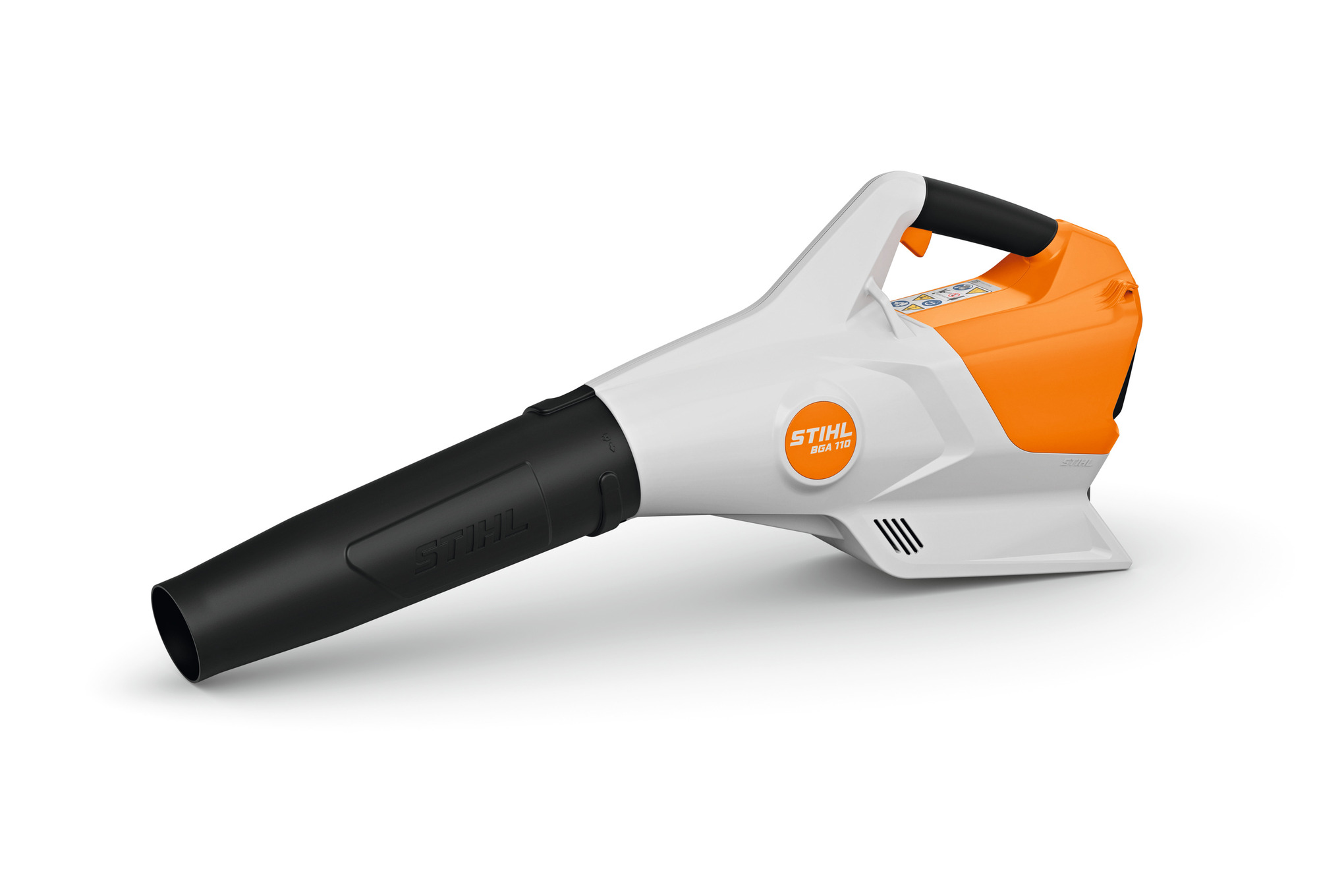
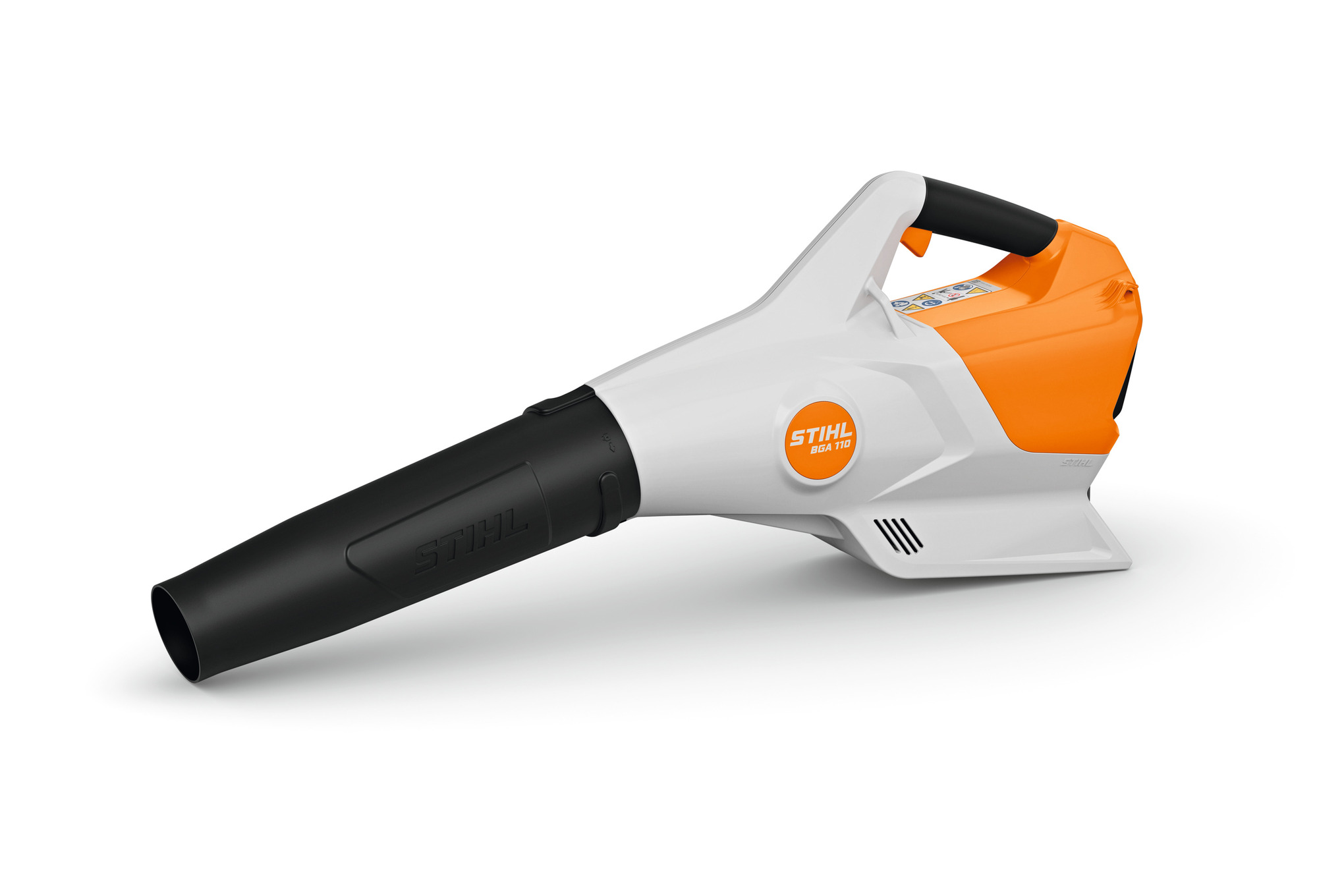
The U.S. product record identifies this configuration as the STIHL BGA 110 (Unit Only), part number BA100115901US, manufacturer record 1049018. “Unit Only” is decisive: the box contains the blower body without a battery or charger. A current STIHL AP-system owner may be able to avoid buying duplicate equipment, but this is not a ready-to-run kit for someone entering the platform. STIHL’s page recommends an AP 30.1 battery; it does not say that pack is included. The exact manual permits STIHL AP and AR batteries, while the product page describes the ALLPRO/AP system. Verify your specific battery and any needed interface with a STIHL dealer before counting an existing pack as compatible.
The blower is a handheld, single-nozzle tool for moving leaves, grass cuttings, paper, dust, and similar light debris. It is not a vacuum or mulcher, and this package has no collection bag. If your fall routine includes collecting leaves for compost or municipal pickup, a blower alone cannot finish that job. A combination vacuum/mulcher is a different tool plan.
Manufacturer ratings show a lighter, moderate-force handheld
STIHL lists 19 newtons with the round nozzle and a 5.3-pound bare-tool weight; 36 volts is the rated voltage. The BGA 110.0 U.S. instruction manual specifies air throughput of 914 cubic meters per hour. Converted from that published metric figure, this is about 538 CFM; the manual also lists 70.6 meters per second maximum air velocity (about 158 mph) and 59 m/s average (about 132 mph). These are manufacturer specifications, not measurements made for this review, and force, velocity, and volume describe different parts of the airflow. They should not be treated as a promise to clear a particular wet leaf pile in a certain time.
The 5.3-pound number is before a battery is installed. Your in-hand weight will be higher and changes with the pack you select; no single loaded weight is assigned here. This is worth checking if wrist fatigue or extended cleanup is a concern. STIHL’s angled tube and aligned handle are intended to reduce wrist-twisting force, and the central layout is described as easier to swivel. Those are design aims, not proof that every operator will find the tool comfortable over a long route. The tube can be removed for storage, but the manual does not turn it into an adjustable-length tube.
Variable output helps with surfaces; Boost is a short burst
A single trigger starts the blower and varies its output, so you can use less force around porch furniture, planting beds, or a narrow path and press harder when pushing clippings from open pavement. Pressing past the trigger’s ordinary travel activates Boost. The manual says Boost supplies maximum power and shortens battery runtime for as long as it is held; there is no reason to treat it as an all-day setting. STIHL’s Constant Power feature is intended to hold output steady as the battery discharges, but it cannot create more stored energy. No exact BGA 110 runtime for a named battery appears in the sources used here, so runtime remains unknown rather than borrowed from another blower.
The product page labels the tool IPX4 for splash protection and describes use in noise-sensitive areas. That should not be read as silent operation or a blanket permission to spray it with water. The manual says the blower can be used in rain, but separately requires wet batteries to dry before use and calls for specific storage and temperature limits. It lists 82 dB(A) sound pressure and 88 dB(A) sound power, with a guaranteed 90 dB(A) sound-power level. Those are distinct acoustic measures; proximity to neighbors and local quiet-hour rules still matter. STIHL recommends hearing protection, and the manual warns about flying debris, requiring eye protection and a 50-foot bystander separation.
How requirements change the shortlist
If 19 N is enough and you already have a compatible battery and charger, the Unit Only format avoids paying for a duplicate setup. Requiring one battery in the same carton or requiring a charger rules this exact SKU out. A 20 N minimum also rules it out: the manufacturer figure is 19 N, not “about 20.” A five-pound bare-tool cap is another hard mismatch because its published body weight is 5.3 pounds. Unknown installed weight must not be used to pass a maximum-weight requirement.
For buyers open to another battery system, the EGO LB6504 is a documented alternative with 650 CFM, 21 N and a 4.77-pound bare-tool figure; the EGO LB7654 steps to 765 CFM and 26 N with a 4.6-pound bare body. Both are handhelds, but they do not accept STIHL packs, and the battery changes what you carry. Their ratings do not promise the same feel, noise, runtime, or cleanup speed as this STIHL. Requiring a different platform is an actual trade, not a reason to assume all 36-volt packs interchange.
There is a same-brand technical step up in STIHL’s BGA 160, listed at 21 N and 570 CFM, but it is also heavier bare and the exact configurations in this library remain references rather than purchase recommendations. The BGA 110 itself is likewise held as a reference pending exact-model safety-status verification; this is not a finding that it is recalled or unsafe. Confirm current model status and battery fit with STIHL before purchase. This is a source-based assessment, not a hands-on test.
Sources: STIHL BGA 110 U.S. product page; STIHL BGA 110.0 U.S. instruction manual 0458-711-9811-A; EGO LB6504 product page; EGO LB7654 product page.
Key details at a glance
| Maximum published air volume | 538 CFM |
|---|---|
| Manual-listed maximum air speed | 158 mph |
| Manual-listed maximum blowing force | 19 N |
| Manufacturer-listed tool weight (check basis) | 5.3 lb |
| Batteries in this kit | 0 |
| Nozzles in the kit | round integrated nozzle |
More specifications and setup details
| Shoulder strap included | No |
|---|---|
| Digital blower display | No |
| Weather resistance | IPX4 |
| String trimmer in kit | No |
| Leaf vacuum and mulching function | No |
| Battery included in package | No |
| Charger included in package | No |
| Blower carrying style | Handheld |
| Package charger class | Not included |
| Power source | Battery |
| Product-page maximum air velocity | 158 mph |
| Weight measurement basis | Exact U.S. product page says 5.3 lb without battery; manual lists 2.4 kg (about 5.3 lb). |
Use the exact model’s instructions for operating limits, supplied equipment and version differences.
Sources for this assessment
Match the blower to your yard and routine.
Compare the exact kit, controls, nozzle and carrying setup before choosing.