
On this page
Your needs, this model
Does it fit your priorities?
Does the BGA 200 Unit Only arrive with the battery and charger needed to run it?
No. The exact page identifies BA010115901US as Unit Only, says the blower has no onboard battery and requires a battery belt or AR-style backpack battery, with adapters separate. STIHL’s manual specifies AP batteries only with the AP Battery Bag with Connecting Cord. A ready-to-run requirement should use an exact kit listing rather than count this model as a supplied pack.
Explore this need in the finder →Does its 553-CFM / 21-N round-nozzle rating meet a 600-CFM and 25-N minimum?
No. The STIHL 2025 U.S. catalog lists 553 CFM at nozzle and the page lists 21 N with a round nozzle. EGO LB7654 (765 CFM / 26 N) and LB8803-2 (880 CFM / 30 N) are different-platform eligible handheld alternatives that clear those floors; the BGA 200 is reference-only and remains excluded.
Explore this need in the finder →Can the 7.1-lb dry body weight prove that the full setup is below a strict carry-weight ceiling?
No. The 7.1-lb catalog figure is blower weight before its separate battery and cord. An AP bag or AR backpack battery and support hardware change the carried total; STIHL does not provide a combined figure for this Unit Only configuration. Do not let an unknown complete carry weight satisfy a hard operating-weight limit.
Explore this need in the finder →A different kind of tool-only blower
The STIHL BGA 200 Unit Only is not a ready-to-run battery kit. The exact U.S. part is BA010115901US. The blower has no onboard battery; STIHL requires a battery belt or AR-style backpack battery and says required adapters are separate. Existing STIHL owners may value that separation, but a first-time cordless buyer must plan for the pack, connection gear and charging equipment before comparing cost or carry weight.
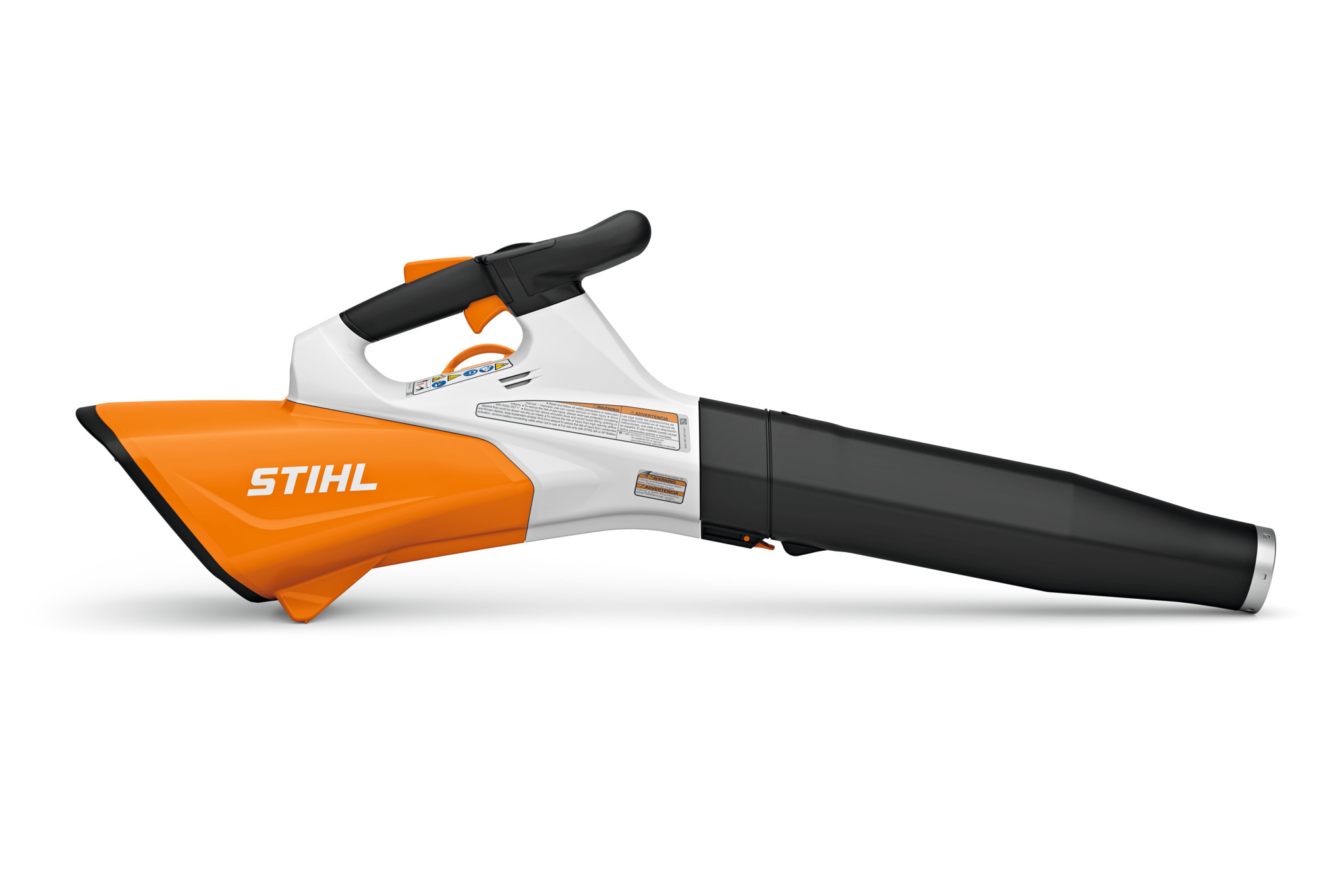
It remains a hand-guided blower, not a conventional backpack blower with the engine and tube on its harness. STIHL describes two working modes, a second handle and a comfort carrying system, letting the user change how the blower is supported. Its sample image shows the tool body and tube, not the battery, cord, harness or carton contents. Confirm the exact support and adapter components for this SKU before treating an accessory as included.
There are two battery plans, not one interchangeable package
The official manual specification extract approves AR batteries and AP batteries used with the AP Battery Bag with Connecting Cord. The exact page recommends the AR 3000 L and identifies AP/ALLPRO compatibility. An AP bag-and-cord setup and an AR backpack setup are distinct plans, not interchangeable harnesses. Confirm the pack, connecting cable and any comfort support hardware for the exact setup you intend to use.
STIHL’s AP System chart shows how much pack choice can change the job. It estimates 49–7 minutes with AP 200 S (the asterisk denotes reduced tool performance), 78–12 with AP 300, 95–14 with AP 300 S, 114–17 with AP 500 S, 315–53 with AR 2000 L, and 500–85 with AR 3000 L. These are manufacturer estimates that vary with use, not promised run times or a single result for the tool-only SKU. The BGA 200 page specifically recommends AR 3000 L; the chart’s AR 3000 L range is the closest published planning figure for that named pack.
Read the output numbers as separate specifications
STIHL’s U.S. full-line catalog lists the BGA 200 at 553 CFM at the nozzle, 188 mph maximum air velocity and 21 N blowing force with the round nozzle. These are manufacturer-published specifications, not measurements made for this review and not a prediction of clearing time on wet leaves or in a crowded bed. CFM describes air volume; mph is a maximum velocity; newtons express force. The catalog lists a round nozzle and shows a flat nozzle as optional. Do not assume the optional nozzle comes in this exact package or that the round-nozzle force figure transfers unchanged to a different attachment.
The catalog gives a dry blower weight of 7.1 pounds, without the battery. That compares the bodies, not your actual load: the pack, harness, cable and optional support add weight, and STIHL does not publish one assembled figure for this SKU. Unknown carry weight should not pass a hard limit. An adjustable tube and metal wear ring improve setup and tube-end durability; neither adds vacuum or mulching function.
Controls and boundaries
The product page describes three power levels with a variable trigger, Boost for stubborn debris, and cruise control that holds a chosen blowing force without continuously squeezing the trigger. Using Boost for long stretches will shorten runtime, so the very broad battery-chart ranges are especially relevant if your work regularly needs maximum force. STIHL calls the tool IPX4 splash protected; that is not an invitation to immerse the blower or battery or to ignore the battery’s own instructions. Use the exact manual’s protective-equipment and operating guidance, keep the air stream away from people, pets, vehicles and windows, and remove the connecting cord before transport, adjustment or storage.
Who should compare it—and what changes with your answers?
The BGA 200 is most interesting to an existing STIHL owner who wants a high-output handheld blower, already understands an external battery-and-cord arrangement, and values the ability to change how the blower is supported during longer jobs. The round-nozzle 21 N rating and 553 CFM catalog value put it below the BGA 250’s 26 N and 615 CFM figures; the BGA 200’s distinction is its separate power pack and two-mode carrying concept, not a higher published output. Its 7.1-pound bare body is also heavier than the BGA 250’s 6.0-pound catalog body, before either battery arrangement is added.
In a finder, requiring a battery and charger in the exact box rejects this Unit Only SKU. Requiring at least 600 CFM and 25 N also rejects it on the published values, even though its round-nozzle 21 N may suit lighter work. A strict under-seven-pound body cap rejects the 7.1-pound bare weight; a full operating-weight ceiling cannot be verified from the bare-body number. If you want a simpler handheld package with one included battery, the separately assessed EGO LB7654 is a different-platform alternative at a published 765 CFM and 26 N; its pack cannot power the BGA 200. If you want a greater published CFM/force figure while staying with STIHL, compare the BGA 250’s exact package and power requirements rather than assuming a common battery setup.
This is a technical-reference review, not a purchase recommendation: current exact-model safety eligibility has not been established. That is not a claim that the blower is recalled or cleared. The article is based on manufacturer materials, not ownership or hands-on testing.
Sources: STIHL BGA 200 Unit Only product page; STIHL BGA 200 U.S. instruction manual 0458-812-8621-A; STIHL AP System Battery Chart; STIHL 2025 full-line U.S. catalog, blower specifications and runtime tables (printed pp. 38–39, 126–127).
Key details at a glance
| Maximum published air volume | 553 CFM |
|---|---|
| Manual-listed maximum air speed | 188 mph |
| Manual-listed maximum blowing force | 21 N |
| Manufacturer-listed tool weight (check basis) | 7.1 lb |
| Batteries in this kit | 0 |
| Nozzles in the kit | round |
More specifications and setup details
| Weather resistance | IPX4 splash protection |
|---|---|
| String trimmer in kit | No |
| Leaf vacuum and mulching function | No |
| Battery included in package | No |
| Charger included in package | No |
| Blower carrying style | Handheld |
| Package charger class | Not included |
| Power source | Battery |
| Product-page maximum air velocity | 188 mph |
| Weight measurement basis | STIHL 2025 full-line U.S. catalog lists 7.1 lb dry; official manual search extract section 24.1 lists 7.1 lb (3.2 kg). Older STIHL web catalog output returned 6.8 lb; the newer 2025 catalog/manual extract values are used while the older catalog discrepancy is preserved in the dossier. |
Use the exact model’s instructions for operating limits, supplied equipment and version differences.
Sources for this assessment
- STIHL BGA 200 Unit Only exact U.S. product page, record 1027148
- STIHL BGA 200 U.S. instruction manual 0458-812-8621-A
- STIHL 2025 Full-Line U.S. Product Catalog, BGA 200 blower row and runtime tables
- STIHL AP System Battery Chart, BGA 200 runtime estimates
- STIHL BGA 200 Unit Only product-page image
- Official CPSC model-specific BGA 200 recall-status query

Match the blower to your yard and routine.
Compare the exact kit, controls, nozzle and carrying setup before choosing.