
On this page
Your needs, this model
Does it fit your priorities?
If backpack carry is essential but gasoline is not, what eligible alternative stays under a 15 lb bare-body ceiling?
EGO LB6000-family battery backpack bodies are listed at 12.5 lb before battery and meet that ceiling. They change the fuel/charging plan; installed battery weight is extra. BR 200 is a gas backpack reference and is not a buying match.
Explore this need in the finder →If I need at least 20 N of published force, can a battery handheld under five pounds meet that floor?
EGO LB6504, LB6703, LB7654 and LB8803-2 have manufacturer-listed force above 20 N and bodies under five pounds; the ST6703LB combo also qualifies but includes a string trimmer. Raising the threshold to 31 N leaves no verified eligible handheld answer. These ratings are not an equal-work-speed test.
Explore this need in the finder →If leaves must be vacuumed and mulched into a bag instead of blown into a pile, what function should I choose?
BR 200 is blower-only. EGO LV5000 and LV5005 are battery handheld vacuum/mulcher blowers with collection bags; LV5000 is tool-only and LV5005 includes battery and charger. If backpack carry is essential, this function has no matching battery backpack in the reviewed set.
Explore this need in the finder →A backpack format for bigger home cleanup
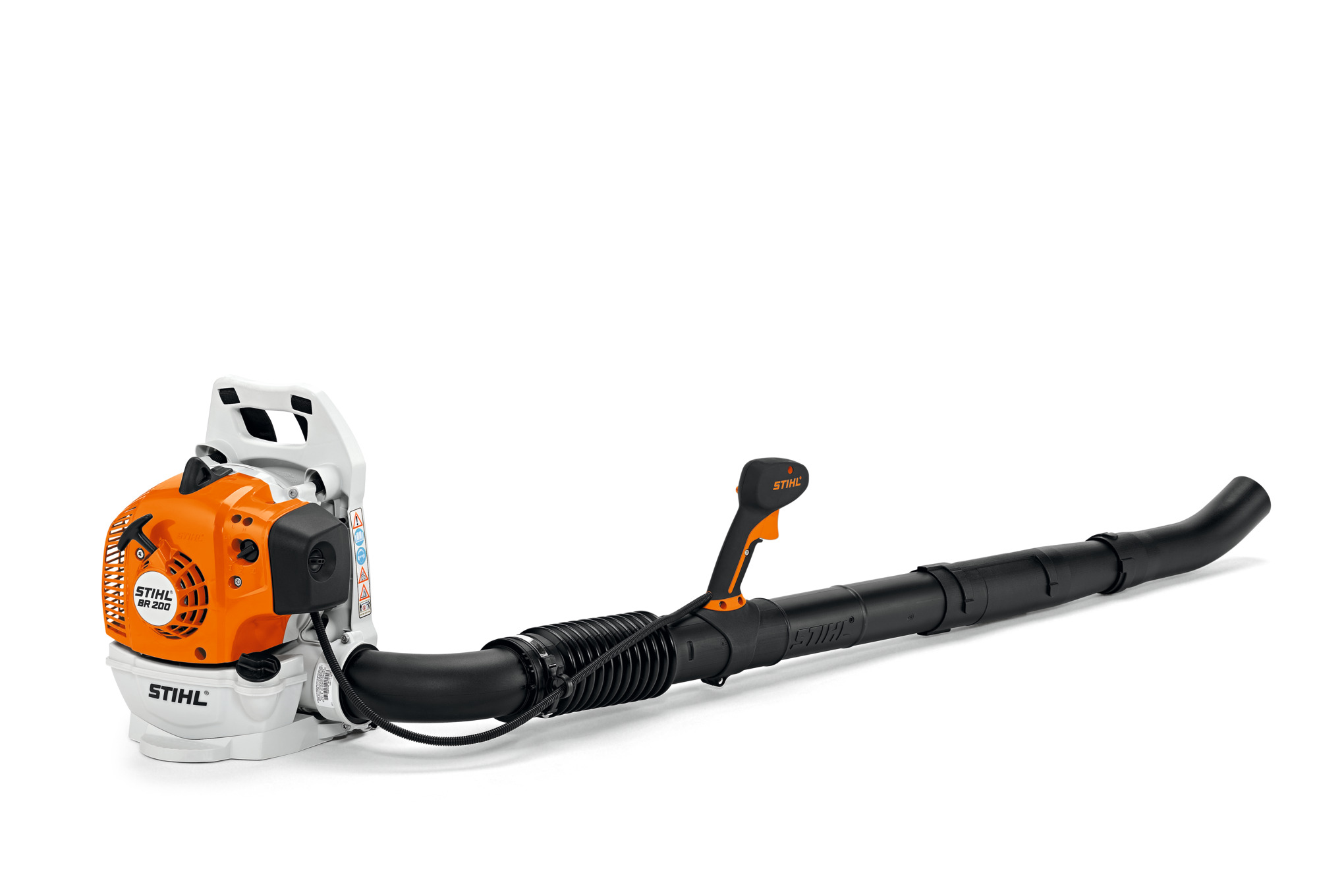
The BR 200 is a small-engine backpack blower rather than a heavy-duty machine that happens to have a harness. STIHL’s current U.S. page describes it for homeowners as well as landscapers and municipal workers, and identifies the selected configuration as part 42410111606US. Its 27.2 cc two-stroke engine and no-fuel mass around 12.5–12.6 pounds place it below STIHL’s larger professional backpack models in size, but still a different commitment from carrying a handheld blower. That distinction is useful for a larger tree-lined lot, long driveway, or repeated seasonal cleanup where holding a motor at arm’s length is tiring. For a small patio and a few clippings, the harness and fuel routine are more than the job needs.
Keep the nozzle and source attached to every number
The current product page lists 12 newtons of blowing force and a maximum round-nozzle air speed of 150.3 mph. STIHL’s official U.S. BR 200 manual gives a more configuration-specific airflow pair: 406 CFM with the nozzle and 471 CFM with the nozzle removed. The manual also lists 132 mph air velocity with the nozzle. Those manual and current-page velocity figures differ, so I would not silently treat them as interchangeable or imply that the faster page number describes a separate measured test. The 471 CFM figure is explicitly the tool without its nozzle; it is not the assembled cleanup setup. These are manufacturer specifications, not field measurements, and none says how quickly the BR 200 will move wet leaves across your property.
The current page calls the tool 12.5 pounds without refueling, while the official manual gives 12.6 pounds without fuel. I use 12.6 as the conservative bare-body value for a weight limit, and the exact manual/page discrepancy remains visible. Neither number includes fuel or describes the worn, working weight. The BR 200 is lighter than STIHL’s larger BR 600 and BR 700 backpacks, but it is not a featherweight cordless handheld. The adjustable harness and padded backplate move the engine’s mass to your back; they do not make that mass disappear.
Gas performance comes with a separate ownership routine
This is a single-cylinder, air-cooled two-stroke gasoline machine. The manual calls for a 50:1 gasoline-and-two-stroke-oil mixture, mid-grade gasoline of at least 89 AKI, and no more than 10% ethanol. STIHL recommends a 35.5-ounce (1.05-liter) tank, but no run-time figure is given; tank volume alone cannot tell you how long it will run at your throttle setting or in your debris. Fuel must be mixed and stored safely, and the manual warns to let a hot tool cool and release tank pressure carefully before opening the cap. Those small rituals matter if you prefer the push-button simplicity of a battery tool.
The BR 200 has a manual fuel-pump primer, choke and recoil starter. Its page advertises a simplified start procedure, but that is not STIHL Easy2Start and not electric starting. The handle places the throttle and setting lever at the operator’s hand, while the backpack frame keeps the engine off the arm holding the tube. STIHL also lists anti-vibration, breathable back padding and an adjustable harness. They may improve comfort, but fit and fatigue vary by wearer; no comfort rating can replace trying the harness on. The vertical pleated-paper air filter is a useful maintenance feature, not a reason to skip the manual’s inspection and service schedule.
Which answers change the shortlist?
If a backpack is essential but gasoline is not, the EGO LB6000 family is a materially different plan worth comparing: its body is 12.5 pounds before battery, and its published 600 CFM / 19 N ratings do not share the BR 200 manual’s nozzle-specific airflow basis. Battery mass is added, and the matching battery package matters. If you require at least 20 N of published force but can switch to a handheld battery blower under five pounds, EGO LB6504, LB6703, LB7654 and LB8803-2 meet that specific rated floor; the EGO ST6703LB trimmer/blower combo also meets it, so include that extra tool only if useful. A 31 N threshold has no verified eligible handheld answer in this library. Those figures are not a promise of equal work speed.
If you need vacuuming and mulching into a collection bag rather than blowing debris into a pile, the BR 200 is the wrong function. The EGO LV5000 and LV5005 are handheld battery blower/vacuum/mulcher configurations with a collection bag; the LV5005 kit includes a battery and charger, while the LV5000 is tool-only. That changes both task and package, not merely power source.
Answering “gas backpack only” remains a real boundary. The BR 200’s identity is documented, but its exact-unit recall status is not established here, so it stays a technical reference and should not appear as a purchase recommendation. STIHL says the product is unavailable for purchase or delivery in California. Its official recall index was checked but does not provide model-specific clearance for the selected BR 200 part number. That is neither a recall finding nor a no-recall guarantee. For an existing machine, identify its serial number and ask an authorized STIHL dealer to check its safety status before use.
Who should pass?
Pass if you want a quiet battery tool, refuse premixed fuel, require Easy2Start, or cannot comfortably carry a backpack load. The BR 200 does not vacuum or collect. It is a source-based technical reference, not a hands-on test or purchase recommendation.
Sources: STIHL U.S. BR 200 product page; official U.S. BR 200 instruction manual 0458-455-8621-E; STIHL U.S. recall notices.
Key details at a glance
| Maximum published air volume | 406 CFM |
|---|---|
| Manual-listed maximum air speed | 132 mph |
| Manual-listed maximum blowing force | 12 N |
| Manufacturer-listed tool weight (check basis) | 12.6 lb |
| Batteries in this kit | 0 |
| Nozzles in the kit | round/straight |
More specifications and setup details
| Shoulder strap included | No |
|---|---|
| String trimmer in kit | No |
| Leaf vacuum and mulching function | No |
| Battery included in package | No |
| Charger included in package | No |
| Blower carrying style | Backpack |
| Backpack support harness | Yes |
| Power source | Gasoline |
| Engine displacement | 27.2 cm³ |
| Engine output | 1.1 hp |
| Fuel tank volume | 1.05 L |
| Air volume at pipe | 406 CFM |
| STIHL Easy2Start | No |
| Gasoline tank capacity | 35.5 oz |
| Two-stroke fuel mixture | 50:1 gasoline/two-stroke engine oil |
| Product-page maximum air velocity | 150.3 mph |
| Weight measurement basis | Official manual lists 12.6 lb without fuel; current product page lists 12.5 lb without refueling. Use 12.6 lb conservatively for body-weight limits. Fueled/worn weight unknown. |
Use the exact model’s instructions for operating limits, supplied equipment and version differences.
Sources for this assessment

Match the blower to your yard and routine.
Compare the exact kit, controls, nozzle and carrying setup before choosing.