
On this page
Your needs, this model
Does it fit your priorities?
If the BR 450’s 28 N floor matters but backpack gasoline does not, what verified lighter-body route can meet a 30 N target?
The reference-only BR 450 remains excluded. The EGO LB8803-2 is a battery handheld with a 30 N manufacturer rating and 4.9 lb body before battery; it changes both carry balance and power source, and its rating does not promise identical clearing speed.
Explore this need in the finder →If backpack carry is essential, can I accept 19 N and a 12.5 lb blower body before adding its battery?
The EGO LB6000 package family is a battery-backpack alternative at 19 N and 12.5 lb before battery. A 20 N floor is different: that family does not meet it, while the reference-only BR 450 is not allowed to fill the gap.
Explore this need in the finder →If I need to vacuum and mulch leaves into a bag rather than blow them into a pile, which function should I choose?
The BR 450 is blower-only. EGO LV5000 and LV5005 are battery handheld blower/vacuum/mulcher tools with a 40 L collection bag; they are not gas backpack substitutes.
Explore this need in the finder →A professional-positioned backpack for demanding cleanup
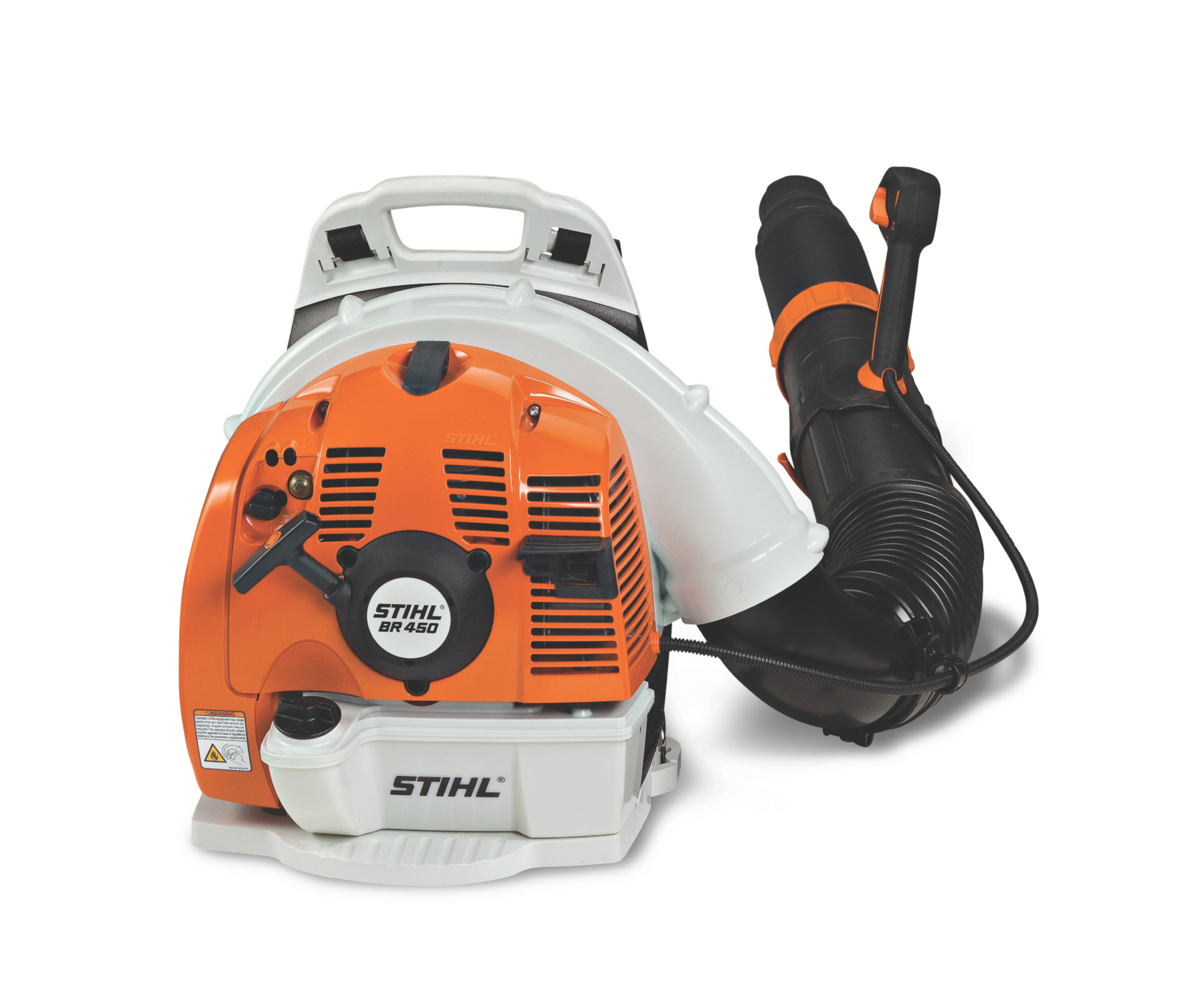
The exact U.S. listing identifies the STIHL BR 450 as a gasoline backpack blower, record 1027371 and part 42440111634US. STIHL describes it for professional landscape-maintenance and municipal work, especially clearing large areas, while its longer description also mentions seasonal leaf removal on large, tree-filled properties. That makes this a serious tool to compare for a large property, but not an automatic answer for a small yard. The household shortlist keeps it as a technical reference rather than a purchase pick because the manufacturer positions it for professionals and because the exact starter description and older family manual do not line up cleanly for this selected part number.
Keep each performance number tied to its setup
STIHL lists 28 newtons of blowing force with a round nozzle, 23.4 pounds without refueling, and a maximum 222 mph air velocity with the round nozzle. Those are manufacturer specifications, not measurements from our own leaf-clearing test. The archived U.S. BR 450 / BR 450 C instruction manual, revision 0458-391-8621-A, separately gives 642 CFM air flow and 186 mph ordinary air velocity; its maximum air velocity is also 222 mph. The manual's 842 CFM figure is the maximum flow with the blower tube assembly removed, not the assembled nozzle configuration. Do not compare the bare-tube number with an attached-nozzle figure as if they describe the same cleanup setup. Neither CFM, force, nor air speed alone guarantees how quickly wet leaves move over grass, gravel, or a bed edge.
The same manual reports a 23.4-pound BR 450 weight without fuel, in agreement with the current page's “without refueling” basis. Fuel, clothing, and any additional equipment add to the load, and no worn operating weight or runtime is published here. The harness moves the engine away from the operator's arm, but it does not erase the mass. The manual's separate BR 450 C figure is 25.4 pounds; do not transfer that C-variant value to this listing's selected non-C part number.
Power comes with mixing, starting, and service duties
The 2018 STIHL manual for the BR 450 and BR 450 C calls the engine a single-cylinder, two-stroke engine and specifies a 50:1 gasoline-to-two-stroke-oil mix. It says to use unleaded gasoline of at least 89 AKI with no more than 10% ethanol. The tank holds 1.7 liters (57.5 fluid ounces), but that capacity is not a run-time promise. Mixing and storing fuel safely, refueling a cool machine outdoors, cleaning the filter, and keeping up with spark-plug and dealer-service checks are part of ownership. That routine is a real difference from plugging in a cord or charging a battery pack.
The BR 450 page highlights a purge-pump primer, semi-automatic choke, adjustable blower-tube length, a repositionable handle, and anti-vibration features. The older family manual documents those controls and a recoil starter. There is an important variant caveat: that manual says the electric starter is for the BR 450 C only, while STIHL's current page for this exact non-C part number says it can be restarted at the push of a button. The current page also does not call this feature Easy2Start. Because the evidence does not reconcile the exact part number and manual revision, this review does not mark push-button starting or Easy2Start as confirmed for 42440111634US. If an easy-start feature is essential, verify the current manual against the serial-number label before relying on it.
What changes when the cleanup brief changes?
If you need a backpack but can exchange gasoline and the BR 450's 28 N page rating for a lighter battery routine, the EGO LB6000 family is a different operating plan: its manufacturer lists 19 N and a 12.5-pound blower body before battery. The pack adds weight, and the published force is lower; that is a substitution only if those tradeoffs fit. If the higher force target matters more than backpack carry, EGO's LB8803-2 handheld package lists 30 N with a 4.9-pound body before battery. That changes both power source and balance in the hand, and does not promise equivalent performance on every surface. If the task is vacuuming and mulching leaves into a collection bag, the BR 450 is the wrong function; the EGO LV5000 and LV5005 are handheld battery blower/vacuum/mulcher configurations with a 40-liter bag, but not backpack gas tools.
No alternative should be forced into a gas-backpack requirement simply to produce a shortlist. In this reviewed set, selecting gasoline and backpack carry leaves the BR 450 and other professional gas backpacks out of purchase matches. A 28 N floor plus that combination has no current household recommendation here. Relaxing the power source, carry style, or performance threshold can reveal real alternatives; relaxing a non-negotiable requirement cannot.
Who should keep looking?
Pass if a 23.4-pound dry backpack body is too much, you prefer a battery-powered routine, or you do not want to handle mixed gasoline. This is blower-only: it does not vacuum or collect debris into a bag. Noise protection, eye protection, bystander spacing, and dust awareness matter; the manual warns against directing the air stream at people and discusses health risks from dust. STIHL also says this model is unavailable for purchase or delivery in California. Its professional-use positioning and the unresolved starter-version bridge keep this assessment informational, not a buying recommendation. STIHL's current page labels its product photos as samples; this image is product-page reference photography, not evidence of a tested unit.
Sources: STIHL U.S. BR 450 product page; STIHL U.S. owners-manual finder; archived 2018 U.S.-English/Spanish STIHL BR 450 / BR 450 C instruction manual 0458-391-8621-A, retrieved from O'Leary's Equipment (an older family edition; check current serial-specific documentation); STIHL U.S. recall notices.
Key details at a glance
| Maximum published air volume | 642 CFM |
|---|---|
| Manual-listed maximum air speed | 222 mph |
| Manual-listed maximum blowing force | 28 N |
| Manufacturer-listed tool weight (check basis) | 23.4 lb |
| Batteries in this kit | 0 |
| Nozzles in the kit | round |
More specifications and setup details
| Shoulder strap included | No |
|---|---|
| String trimmer in kit | No |
| Leaf vacuum and mulching function | No |
| Battery included in package | No |
| Charger included in package | No |
| Blower carrying style | Backpack |
| Backpack support harness | Yes |
| Power source | Gasoline |
| Engine displacement | 63.3 cm³ |
| Engine output | 3.9 hp |
| Fuel tank volume | 1.7 L |
| Air volume at pipe | 642 CFM |
| Gasoline tank capacity | 57.5 oz |
| Two-stroke fuel mixture | 50:1 gasoline/two-stroke oil |
| Product-page maximum air velocity | 222 mph |
| Weight measurement basis | Exact U.S. product page lists 23.4 lb without refueling; the 2018 family manual lists 23.4 lb for BR 450 and a distinct 25.4 lb for BR 450 C. Fuelled/worn mass is not stated. |
Use the exact model’s instructions for operating limits, supplied equipment and version differences.
Sources for this assessment
- STIHL U.S. BR 450 product page, exact record and selected part
- STIHL BR 450 / BR 450 C U.S.-English/Spanish Instruction Manual, revision 0458-391-8621-A (2018)
- STIHL U.S. owners-manual finder linked from exact BR 450 page
- STIHL U.S. exact BR 450 product-page sample image
- STIHL U.S. Product Recall Notices page checked for BR 450

Match the blower to your yard and routine.
Compare the exact kit, controls, nozzle and carrying setup before choosing.