
On this page
Your needs, this model
Does it fit your priorities?
If backpack carry matters but gasoline does not, what eligible option stays below a 15 lb bare-body ceiling?
The BR 600 is a 22.3 lb gas backpack reference, not a purchase match. The EGO LB6000 family has a 12.5 lb bare body and an eligible battery backpack plan, but the installed battery adds weight and uses a different platform.
Explore this need in the finder →Can a battery handheld clear a 30 N published-force floor if you give up the gas backpack format?
The EGO LB8803-2 lists 30 N and is eligible as a battery handheld. It meets that precise published floor but not a 31 N minimum, and it is not equivalent in carry style or fuel plan to the BR 600.
Explore this need in the finder →Do you insist on gas backpack power, even if no reviewed configuration is cleared for purchase matching?
The BR 600 matches the machine type technically, but remains reference-only while exact model-specific CPSC status is unestablished. Its serial-limited 2011 fuel-cap notice also makes serial checking important for older units; a battery backpack answer changes the maintenance plan rather than silently substituting a gas blower.
Explore this need in the finder →A professional backpack format, not a casual-yard default
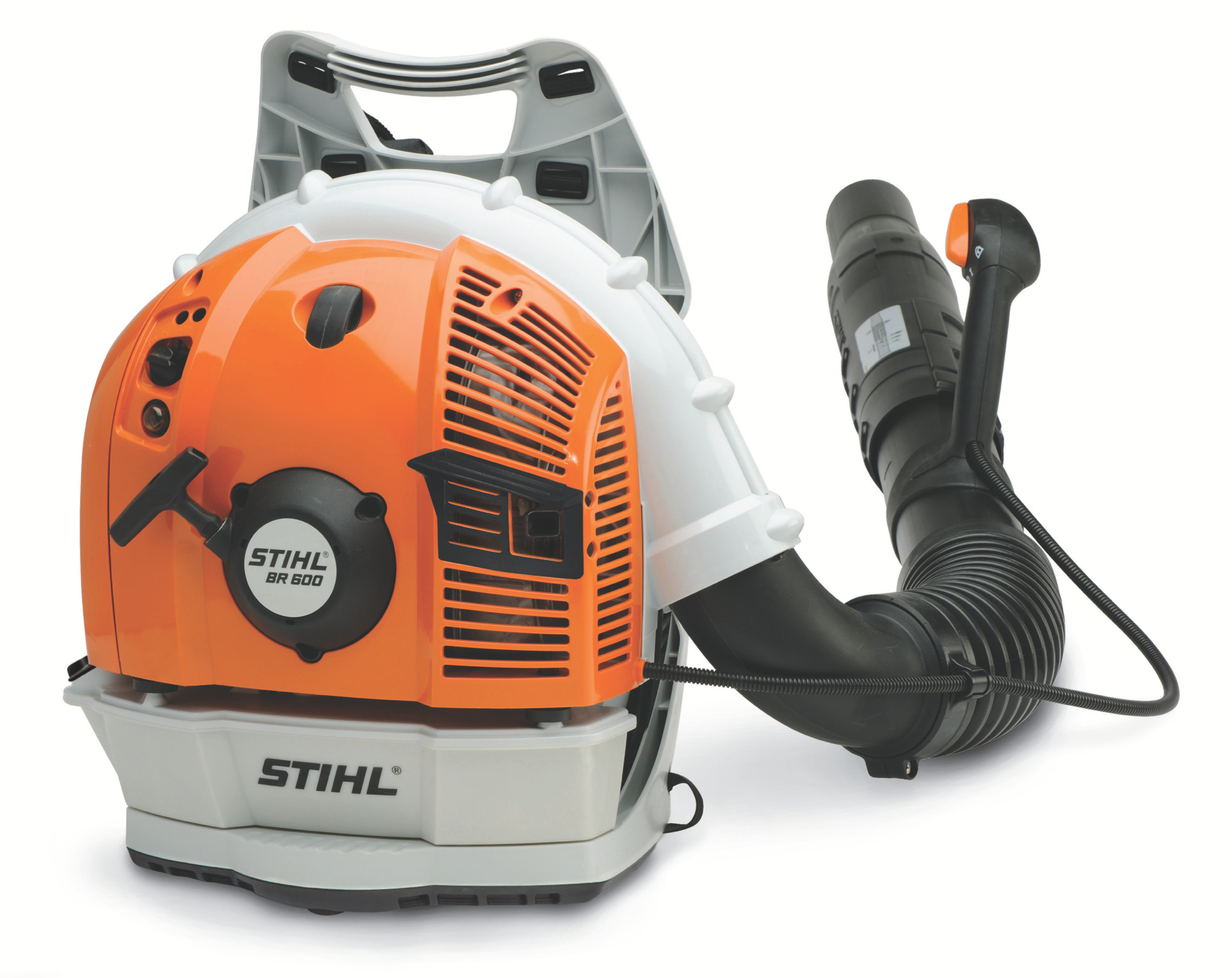
The U.S. STIHL page identifies the BR 600 as a gasoline backpack blower, part number 42820111632US. It positions the machine for professional landscaping, grounds maintenance and municipal work, and says it is intended to clear leaves, hedge cuttings and other debris from large areas. That emphasis matters. A homeowner with a broad lot and long fall cleanup may appreciate carrying the motor on a harness rather than holding a heavy blower at arm’s length, but a small driveway does not justify a 64.8-cc backpack machine, mixed fuel and its substantial body weight. This is a demanding-work reference, not a universal residential pick.
Read the airflow figures with their nozzle and source attached
STIHL’s current U.S. product table lists 31.7 newtons of blowing force with the round nozzle, 237.6 mph maximum air velocity with that nozzle and 22.3 pounds without refueling. The page’s descriptive copy rounds the force to 32 N. The U.S. BR 500/600 instruction manual (0458-452-8621-J) also rounds force to 32 N, and its specification section reports 199 mph air velocity, 677 CFM with the blower tube and 812 CFM without the blowing unit. Those are manufacturer-published figures, not a yard test. A previously indexed STIHL U.S. BR 600 page gave 686 CFM with the round nozzle; that legacy URL now redirects to the current page, so the historic entry is retained as an indexed discrepancy, not treated as a current second test. The airflow figures are therefore not perfectly aligned across STIHL’s materials. Keep the attached configuration clear: the manual’s 812 CFM without the blower unit is not the assembled, round-nozzle setup. None of these figures predicts how fast wet leaves move on your slope.
The 22.3-pound figure is before fuel. It is a body that rides on your back, but it is still a substantial load; fuel adds weight, and the manual does not give a fueled operating total. The adjustable support harness, padded backrest and hip belt are intended to distribute it. STIHL also describes a four-point anti-vibration system, though comfort depends on fit, posture, clothing and work duration. If you want a hard cap near 15 pounds before fuel, this machine is plainly the wrong size class.
Four-MIX keeps the fuel routine in the picture
The 4-MIX engine operates on the four-stroke principle but uses mixture lubrication. The manual therefore specifies a gasoline-and-two-stroke-oil mix at 50:1; STIHL’s current page recommends gasoline with no more than 10% ethanol. It is not a battery tool and it is not a conventional four-stroke machine with a separate oil sump. Owners need the right premix, safe fuel handling, periodic air-filter and spark-plug care, and room for a service routine. The manual lists a 1.4-liter (47.3-ounce) maximum tank. That capacity is not a promise of a particular runtime because no workload-specific fuel-use figure is supplied here.
Controls include a multi-function handle, throttle trigger lock with a momentary stop, purge-pump primer and a simplified starting procedure. The tube adjusts among three positions, which can help set the reach to your height and task. The primer supports startup but does not make this an electric-start product; it still involves a gasoline engine and recoil-start procedure. STIHL calls out a spark-arresting screen and directs operators to follow its safety instructions. Wear eye and hearing protection, keep bystanders clear, and check local operating rules before using a high-output gas blower near neighbors.
What changes when you answer the finder
If backpack carry is essential but you will accept battery power, the EGO LB6000 family becomes a more plausible route for a body-weight ceiling around 15 pounds. Its 12.5-pound bare-body figure is lower than the BR 600’s 22.3 pounds, but the pack adds mass and EGO does not share STIHL batteries. The answer changes the power and charging plan, not just the color or brand. If you instead prioritize a published 30 N floor and can switch to a handheld, the EGO LB8803-2 is listed at 30 N; it does not meet a stricter 31 N minimum, and it is not a backpack replacement in handling or balance. Requiring gas and backpack together is a real constraint: this review is reference-only, so it should not appear as an eligible purchase result.
There is also a model-status boundary. STIHL’s U.S. product page says the BR 600 is not available for purchase or delivery in California. Its 2011 tool-less fuel-cap notice covered BR 600 machines only up to serial number 284053456; that limited range must not be generalized into a recall of every BR 600. The U.S. Consumer Product Safety Commission’s 2011 notice independently lists BR 600 units only through serial number 284053456. That is a specific serial-limited recall, not a recall of every BR 600, and the selected retail part number does not reveal the serial number of an individual unit. This configuration therefore remains outside buying recommendations until the actual unit is checked. For a used machine, have an authorized dealer verify its serial number and fuel cap before use. This is a source-based review, not a hands-on test, and there is no basis here to claim a universal safety clearance.
Sources: STIHL BR 600 U.S. product page; STIHL U.S. BR 500/BR 600 instruction manual 0458-452-8621-J via the official manual finder; STIHL tool-less fuel-cap recall notice; CPSC’s 2011 recall notice; EGO LB6000 product page; EGO LB8803-2 product page.
Key details at a glance
| Maximum published air volume | 677 CFM |
|---|---|
| Manual-listed maximum air speed | 199 mph |
| Manual-listed maximum blowing force | 31.7 N |
| Manufacturer-listed tool weight (check basis) | 22.3 lb |
| Batteries in this kit | 0 |
| Nozzles in the kit | round |
More specifications and setup details
| Shoulder strap included | No |
|---|---|
| String trimmer in kit | No |
| Leaf vacuum and mulching function | No |
| Battery included in package | No |
| Charger included in package | No |
| Blower carrying style | Backpack |
| Backpack support harness | Yes |
| Power source | Gasoline |
| Engine displacement | 64.8 cm³ |
| Fuel tank volume | 1.4 L |
| STIHL Easy2Start | No |
| Gasoline tank capacity | 47.3 oz |
| Two-stroke fuel mixture | 50:1 gasoline/two-stroke oil mix; STIHL 4-MIX has mixture lubrication but otherwise follows the four-stroke principle |
| Product-page maximum air velocity | 237.6 mph |
| Weight measurement basis | Exact current U.S. page and indexed manual both list 22.3 lb without refueling/without fuel. Fuelled worn weight is unknown. |
Use the exact model’s instructions for operating limits, supplied equipment and version differences.
Sources for this assessment
- STIHL USA BR 600 exact U.S. product page and selected part number
- STIHL BR 500 / BR 600 U.S. instruction manual 0458-452-8621-J
- STIHL U.S. 2011 tool-less fuel-cap recall notice
- STIHL USA BR 600 exact product-page sample image
- U.S. CPSC 2011 STIHL tool-less fuel-cap recall notice
- STIHL U.S. legacy BR 600 product page, indexed specification record

Match the blower to your yard and routine.
Compare the exact kit, controls, nozzle and carrying setup before choosing.