
On this page
Your needs, this model
Does it fit your priorities?
Can I keep a 30 N published-force floor while avoiding this 23.6 lb gas backpack body?
EGO LB8803-2 is a battery handheld with a manufacturer-listed 30 N rating and a 4.9 lb body before its battery. That changes the carry format and energy routine; neither rating promises equal clearing speed. The BR 700 stays a professional-use reference here.
Explore this need in the finder →If I still want backpack carry but need a lighter, fuel-free body, what changes?
The EGO LB6000 package family is listed at 12.5 lb before battery and 19 N; the pack adds mass. It replaces the BR 700’s 50:1 fuel plan with battery charging, and is not an equal-output substitute. The BR 700 is not a household-finder purchase match.
Explore this need in the finder →Do I need a blower to move leaves, or a handheld machine that vacuums and bags them?
BR 700 is a blower-only backpack, not a vacuum/mulcher. The handheld EGO LV5000 tool-only and LV5005 battery/charger kit add collection and mulching capability; those packages change both the task and carry plan.
Explore this need in the finder →A professional-scale backpack, not a small-yard convenience tool
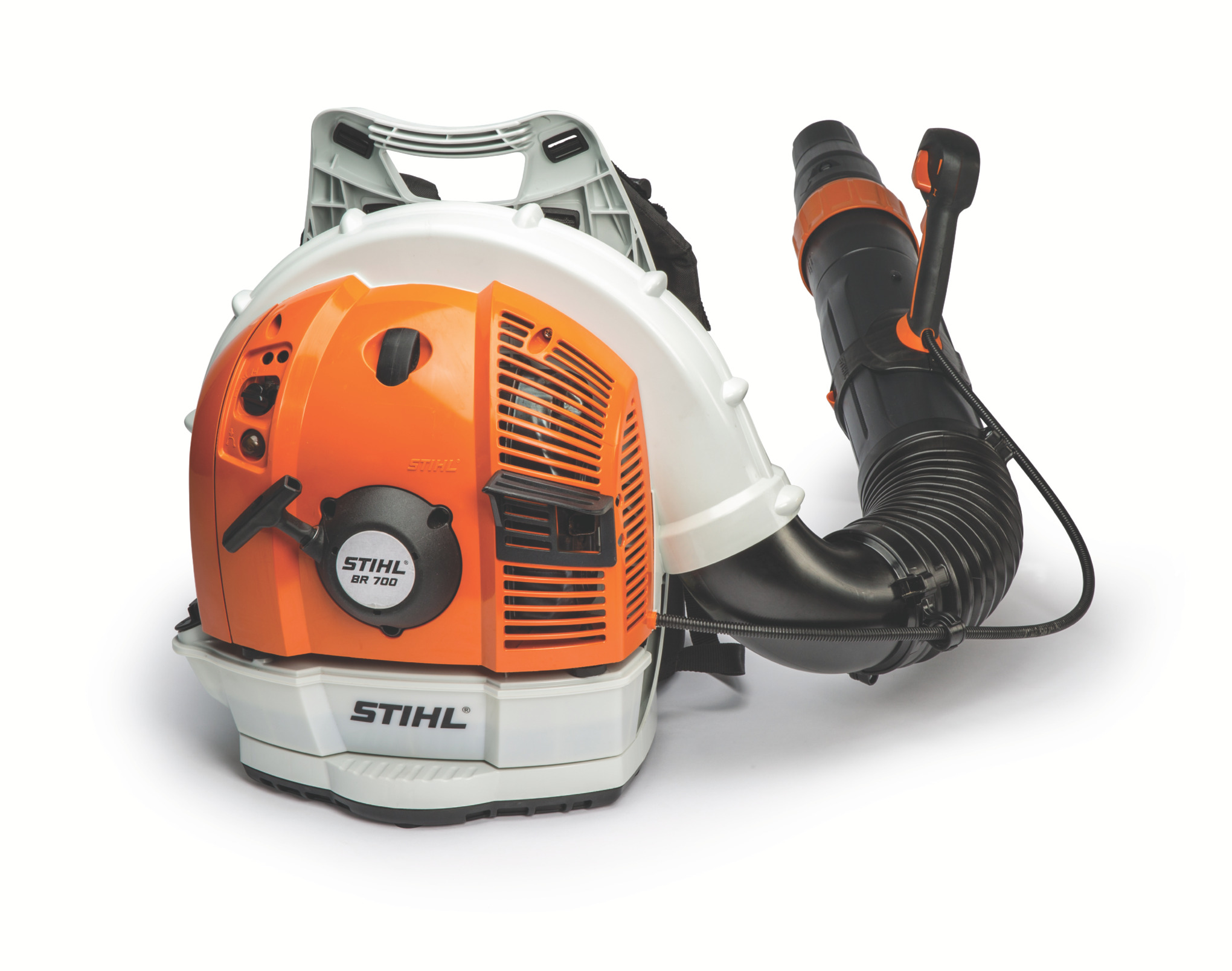
The current U.S. STIHL listing identifies a BR 700 gasoline backpack blower, record 1027339, with selected part 42820111638US. The page describes it for professional landscaping, garden maintenance, and municipal work over large areas. That audience cue is the useful first filter: this is a substantial carried engine for repeated large-area cleanup, not a light tool for patio crumbs. Our household finder keeps this professionally positioned model as a technical reference, not a residential pick; that is a category choice, not a claim that home operation is prohibited.
Keep the manual figures attached to their setup
The exact product page gives 35 newtons of blowing force with a round nozzle, 23.6 pounds without refueling, and a maximum round-nozzle air velocity of 196 mph. The STIHL BR 700/BR 700 X U.S. manual (0458-459-8621-F) separately lists 165 mph air velocity and 912 CFM air flow for the BR 700, plus 1,095 CFM with the blowing unit removed. The last figure is not the attached-tube cleanup configuration. These are manufacturer specifications, not our own measurements. Do not treat ordinary air velocity, maximum velocity, and the page’s nozzle-specific maximum as interchangeable proof of clearing speed; debris, surface, moisture and technique still matter.
The current exact-model page and manual both list 23.6 pounds without fuel; the weight is not a fueled or worn total. None of these numbers is a fueled or worn weight. The manual lists a 1.4-liter (47.3-ounce) maximum fuel tank, but that is a capacity, not an operating-mass measurement or runtime promise. You carry the body on its harness, and fuel adds to the load.
Four-MIX still means mixed fuel and routine care
STIHL calls the engine 4-MIX, but the manual’s U.S. fuel instructions require a 50:1 gasoline-and-two-cycle-oil mixture for an air-cooled engine, with at least 89 AKI gasoline and no more than 10% ethanol. STIHL recommends its own MotoMix or HP Ultra oil, and the manual warns against NMMA/TCW marine oil. That operating plan is a real ownership distinction from a battery blower: you must measure and safely store premix, refuel outdoors with the machine off the back, and accept exhaust, engine noise, and periodic filter, spark-plug, and servicing tasks. The manual warns that power-tool noise may damage hearing and calls for appropriate hearing and eye protection; it is not an indoor tool.
Starting is still a manual-engine routine. The product page names a purge-pump primer, a semi-automatic choke, and a simplified starting sequence; the manual shows the primer, choke control, and recoil starter. It is not an electric start. A multi-function handle puts the controls at the tube, while the harness and backrest carry the power unit. STIHL also advertises anti-vibration and adjustable support. Those are useful design features, but they cannot guarantee a comfortable fit or erase the dry weight for every wearer. Try the harness with the kind of clothing you will use and read the manual before handling fuel or starting the engine.
Tube adjustment and nozzle choice change the job
The manual identifies the union nut on the BR 700 as its blower-tube length adjustment. The control handle also moves without tools. Those adjustments tailor reach and hand position. The exact page’s performance figure is for a round nozzle. STIHL separately sells an adjustable round nozzle compatible with the BR 700; do not assume that optional attachment is in the selected package. The manual requires an assembled tube and nozzle and says to use supplied or expressly approved attachments.
What changes when your answers change?
If the useful part of the BR 700 is its published force but you do not want a 23.6-pound gas backpack, the EGO LB8803-2 offers a very different route: its manufacturer lists 30 N in a roughly 4.9-pound bare handheld body. That is a strong published rating in a much lighter body, but a handheld changes balance and fatigue, the battery adds weight, and the rating does not promise equal work speed. If backpack carry itself is essential but a lighter, fuel-free plan matters more than the BR 700’s 35 N, the EGO LB6000 family is listed at 12.5 pounds before battery and 19 N. The pack adds mass; you trade the gas refill/maintenance routine for charging and battery planning. Those are alternatives only if the power and carry changes are acceptable.
If you need to collect and mulch leaves into a bag rather than move them into a pile, the BR 700 is the wrong function. EGO’s LV5000 and LV5005 are handheld battery blower/vacuum/mulcher combinations; one is tool-only and the other is a battery-and-charger kit. If backpack carry, gasoline, or a 35 N floor is non-negotiable, those vacuum options do not meet the whole request. In the finder, exact function and carry style should outrank a headline force number.
Where this model belongs—and where it does not
The BR 700’s 64.8 cc engine, 35 N page rating, adjustable tube and large tank target professional-scale cleanup. Those traits do not make it a natural fit for a small lot, noise-sensitive neighborhood, fuel-averse buyer or strict weight limit. STIHL says the product is unavailable for purchase or delivery in California. The professional-use positioning keeps it as a comparison reference here; this review makes no recall or universal safety-clearance claim.
Sources: STIHL U.S. BR 700 product page; STIHL U.S. BR 700 / BR 700 X instruction manual 0458-459-8621-F; STIHL U.S. BR 600 product page; EGO LB8800-family product page; EGO LB6000-family product page; EGO LV5000 product page.
Key details at a glance
| Maximum published air volume | 912 CFM |
|---|---|
| Manual-listed maximum air speed | 165 mph |
| Manual-listed maximum blowing force | 35 N |
| Manufacturer-listed tool weight (check basis) | 23.6 lb |
| Batteries in this kit | 0 |
| Nozzles in the kit | round |
More specifications and setup details
| Shoulder strap included | Yes |
|---|---|
| String trimmer in kit | No |
| Leaf vacuum and mulching function | No |
| Battery included in package | No |
| Charger included in package | No |
| Blower carrying style | Backpack |
| Backpack support harness | Yes |
| Power source | Gasoline |
| Engine displacement | 64.8 cm³ |
| Fuel tank volume | 1.4 L |
| Air volume at pipe | 912 CFM |
| STIHL Easy2Start | No |
| Gasoline tank capacity | 47.3 oz |
| Two-stroke fuel mixture | 50:1 gasoline / air-cooled two-cycle engine oil per STIHL U.S. manual 0458-459-8621-F; minimum 89 AKI gasoline, maximum 10% ethanol. Manual says not to use NMMA or TCW oils. |
| Product-page maximum air velocity | 196 mph |
| Weight measurement basis | The exact U.S. product page lists 23.6 lb without refueling and official U.S. manual lists 23.6 lb without fuel. Fuelled/worn operating mass is not stated and must not be inferred. |
Use the exact model’s instructions for operating limits, supplied equipment and version differences.
Sources for this assessment

Match the blower to your yard and routine.
Compare the exact kit, controls, nozzle and carrying setup before choosing.