
Your needs, this model
Does it fit your priorities?
Does the 51821 kit include a battery and charger large enough for your selected minimum?
The exact package includes one 2.0 Ah / 108 Wh L108 battery and a 1 A charger. Toro’s manual distinguishes 51821 from 51821T, which has no battery or charger.
Explore this need in the finder →Does Toro’s published 565 CFM maximum meet your minimum airflow need?
Toro lists up to 565 CFM and 110 mph on Turbo boost under controlled laboratory testing. This is not an independent clearing-time or blowing-force result.
Explore this need in the finder →Is a known ready-to-use weight essential for your choice?
Toro lists 9.7 lb but gives no bare-tool or battery-installed basis. Neither that listing nor the manual confirms operating weight, so a strict essential weight ceiling remains unknown.
Explore this need in the finder →What the 51821 kit actually adds
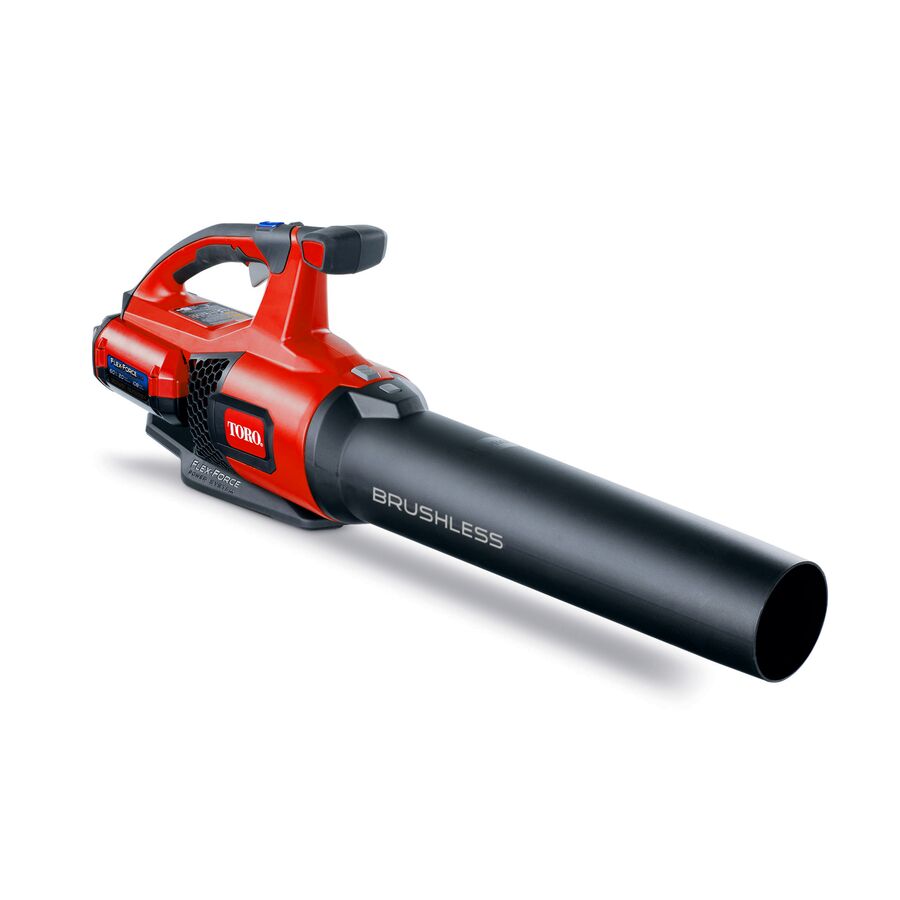
Toro’s 51821 is the battery-and-charger package for its Flex-Force 60V handheld axial blower rated at up to 565 CFM and 110 mph. Toro says those maximums are reached with Turbo boost in controlled laboratory testing; they are not a promise that a particular wet pile or packed curb line will clear at a certain rate. This distinction matters because the 51821’s most practical advantage over some larger blowers is not a lab number by itself: it arrives with a 2.0 Ah battery and charger, so a homeowner without an existing Toro pack can use the kit as a starting point.
The exact U.S. product page lists an L108 2.0 Ah / 108 Wh battery, one battery and one charger. The serial-applicable operator manual identifies a 2.0 Ah pack and a 1-amp charger as the components included with model 51821. Toro’s current product specifications list a charge time of 103 minutes and up to 70 minutes of runtime. An older Toro comparison chart instead says up to 90 minutes on low for the 51821. The claims conflict, and the current page does not say which speed or test conditions produce its 70-minute figure. Treat either as a manufacturer maximum, not a reliable estimate for repeated Turbo work.
How to read the power and controls
The 565 CFM and 110 mph figures put this below the 605 CFM / 157 mph 51822 on Toro’s published maximums. It is also a different configuration from Toro’s 605 CFM 51820 kit: that model lists a larger 2.5 Ah battery and a 120 mph maximum, while the 51821 uses the smaller L108 pack. Those comparisons can help set expectations, but airflow and air speed are different measures. They do not independently prove which machine will move a particular type of debris better, and the public materials do not provide a standardized blowing-force figure.
The 51821 has a variable-speed trigger, a speed lock (Toro’s manual uses that name for the control that maintains a selected speed), and a separate Turbo button. That gives a useful sequence for ordinary work: use only the trigger pressure needed for dry leaves on a path, lock a comfortable setting for a longer pass, and reserve Turbo for short areas where stronger airflow is useful. Toro’s manual explicitly advises using only as much speed as required and directing discharge away from people, pets, windows and vehicles. Higher-speed work should not be mistaken for the longest-running mode.
Fit the kit to the job, not a CFM slogan
This package makes the most sense for a homeowner who wants a cordless handheld blower and needs its battery and charger included. It may fit routine patio, sidewalk, driveway-edge and dry-leaf cleanup where the user can move debris in manageable passes. The manufacturer’s current comparison chart describes model 51821 as an everyday-cleanup option; that is a product-positioning statement, not an independent field test. If your work often involves sticky debris, deep drifts, or a large property where frequent high-speed operation is essential, compare the 51822’s larger 4.0 Ah kit and higher published air-speed maximum before choosing.
The exact page lists a weight of 9.7 lb, but it does not define whether that is bare-tool, battery-installed or otherwise. The manual does not give a complete operating weight. This is not enough evidence for someone with a strict carry-weight ceiling. The page and manual also do not provide a numeric sound-pressure value at a stated distance, a quantified blowing force, or a shape-specific nozzle specification. If any of those are essential, this configuration should not pass the requirement on assumption.
Setup, safety and ownership limits
The manual covers models 51821 and 51821T beginning with serial 325000000. It shows the kit battery and charger and explains how to attach the blower tube, engage the speed lock, use Turbo, remove the pack, charge it and store the tool. It specifies Flex-Force 60V lithium-ion batteries and chargers rather than generic packs that merely share a voltage label. Toro specifies charging and storage from 41°F to 104°F and blower operation from 32°F to 120°F. The manual says not to use the tool in rain or damp or wet locations, to wear eye and hearing protection, and to remove the battery before cleaning, adjustment, transport or storage.
Choose the 51821 when a complete Toro kit with a modest-capacity 2.0 Ah battery is the right package and the documented maximums suit your cleanup plan. Choose the 51821T only if you already have a compatible Toro 60V battery and charger; it is a different tool-only package, not a cheaper complete kit. Step up to the 51822 if its higher published maximums and 4.0 Ah battery matter more than its listed 13 lb weight (also without a defined basis). For a lower airflow requirement or a different power platform, compare other handheld models rather than treating the 51821’s laboratory maximum as a universal yard-performance ranking.
Sources: Toro 51821 U.S. product page, current Toro serial-range parts record, Toro Form 3472-153 Rev B operator manual, and the previously archived Toro U.S. blower comparison chart.
Key details at a glance
| Maximum published air volume | 565 CFM |
|---|---|
| Batteries in this kit | 1 |
| Capacity of each included battery | 2 Ah |
| Exact package configuration | Exact U.S. kit. Toro’s applicable manual separately identifies 51821T as the version without a battery or charger. |
| String trimmer in kit | No |
| Leaf vacuum and mulching function | No |
| Battery included in package | Yes |
| Charger included in package | Yes |
| Blower carrying style | Handheld |
| Backpack support harness | No |
| Package charger class | 1 a (manual figure) |
| Power source | Battery |
| Product-page maximum air velocity | 110 mph |
| Manufacturer-listed weight | 9.7 lb |
| Weight measurement basis | Toro lists 9.7 lb on the exact product page but does not define whether this is bare-tool, battery-installed or another basis; do not treat it as a verified operating mass. |
Use the exact model’s instructions for operating limits, supplied equipment and version differences.
Sources for this assessment
- Toro exact U.S. model 51821 product page
- Toro exact model 51821 serial-range parts listing
- Toro Form 3472-153 Rev B operator manual; exact model/serial applicability
- Previously archived Toro U.S. 60V blower comparison chart
- Previously archived Toro recall page
- Previously archived CPSC leaf blower recall listing
Match the blower to your yard and routine.
Compare the exact kit, controls, nozzle and carrying setup before choosing.