
Your needs, this model
Does it fit your priorities?
Do you want one gas handheld that can switch from blower use to leaf vacuuming and shredding into a bag?
ECHO lists blower pipes and a separate vacuum tube, discharge elbow and two-bushel debris bag for the ES-250. It changes modes rather than blowing and collecting at once; in vacuum mode ECHO limits the work to dry leaves and small twigs, not wet leaves, rocks or larger branches.
Explore this need in the finder →Would the manual-backed 391 CFM blower setup meet your airflow floor, or do you need a higher published maximum?
The current ECHO support page and serial-group manual list 391 CFM and a 165 mph maximum. The product page says 392 CFM; the matcher uses 391 because it is the conservative value repeated in current specifications. A 392-CFM hard floor is not confirmed by the manual-backed sources.
Explore this need in the finder →Is a two-bushel leaf bag large enough, or is a 75-liter minimum essential?
ECHO describes a two-bushel rear-zip collection bag, approximately 70.5 L by conversion. It clears a 70 L floor, not a 75 L requirement. ECHO does not promise fewer emptying stops or a particular yard coverage per fill.
Explore this need in the finder →Would a strict vacuum-mode weight limit rule it out if ECHO has not published one clear configuration weight?
The product page lists 12.6 lb dry, while ECHO support and its current indexed manual list 9.5 lb dry; those sources do not resolve configuration basis or complete vacuum-mode mass. A hard maximum is not verified, even though blower airflow and the two-bushel bag are documented.
Explore this need in the finder →A blower that changes jobs, not a vacuum that blows at the same time
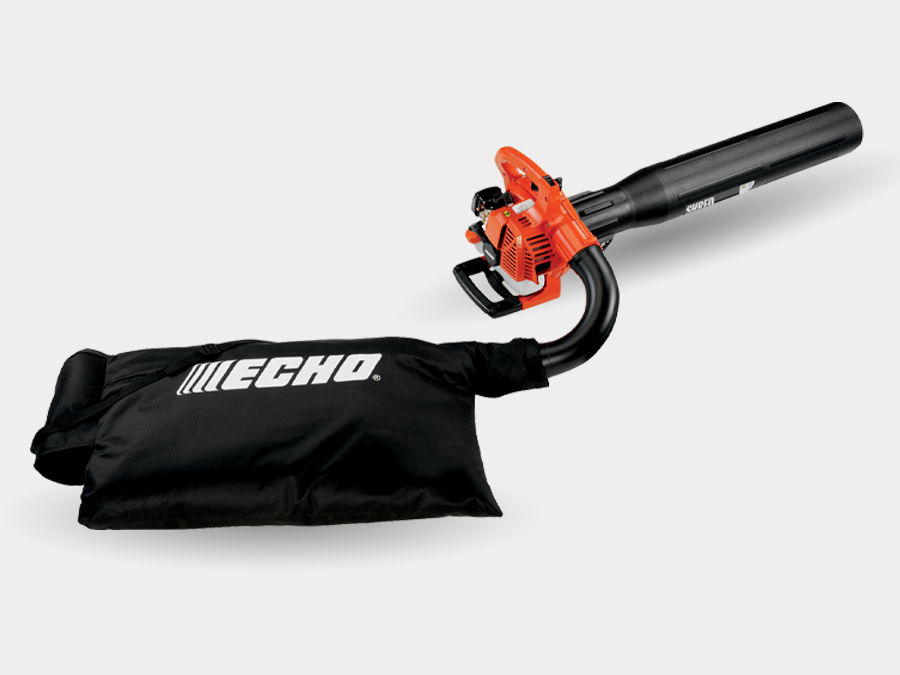
The ECHO ES-250 is a handheld 25.4 cc two-stroke machine designed to run either as a blower or as a leaf vacuum and shredder. Its distinctive value is the conversion kit: ECHO lists the upper and lower blower pipes, a separate suction tube, an elbow, and a two-bushel rear-zip collection bag. Changing the tubes changes the work plan; the tool is not blowing and collecting simultaneously. This arrangement can be useful when one small yard has both hard surfaces to clear and dry leaves that are worth bagging, and the owner prefers one powerhead over a separate blower and vacuum.
In blower mode, ECHO describes a curved tube for rotational control and publishes 165 mph maximum air speed. There is a small but meaningful specification disagreement: the exact product page says 392 CFM, while ECHO's support table and current serial-group manual list 391 CFM, with 140 mph average and 165 mph maximum. These are manufacturer ratings, not observed clearing speed. For a strict CFM requirement, treat 391 as the documented floor rather than assuming the page's rounded 392 value. Buyers who need materially more airflow should compare a higher-output blower, not expect the vac bag or shredder to increase the ES-250's blower rating.
The vacuum mode is for light, dry material
The machine's second setup adds a 35-inch intake tube and a bag ECHO describes as two bushels. The manufacturer says its four-blade mechanism reduces debris by a 12:1 ratio; that is a manufacturer claim, not a guarantee of a particular finished mulch texture. The bag is about 70.5 liters by conversion, which makes a 70-liter minimum plausible but does not mean every yard can be cleared without frequent emptying. ECHO's manual says to empty it before the debris reaches the intake and keep the strap arranged so the bag does not fold over its inlet.
Use the blower mode first to gather loose leaves, then vacuum manageable dry material. The manual cautions against wet leaves and hard debris such as rocks, brush and sticks; it limits twigs to about 1/4 inch in diameter by 3 inches long. A clogged or jammed intake is not a minor inconvenience because the fan housing contains sharp shredder blades. Stop the engine, disconnect the spark plug and wait for all motion to stop before clearing or servicing the unit. During vacuuming the bag must be secured to the elbow and kept away from the hot muffler and exhaust. The shoulder strap supports the collection bag, but does not turn this handheld engine into a backpack blower.
Its upkeep is still a gasoline routine
The ES-250 uses a two-stroke gasoline engine, standard recoil starter, choke, purge bulb and throttle-position lever. ECHO specifies a 50:1 fuel-and-oil mix and fresh 89-octane unleaded gasoline, with fuel-composition restrictions in the manual; do not substitute E-15 or E-85. That means preparing and storing premix safely, pulling a starter and maintaining a combustion engine. The 0.5-liter tank is listed as 16.9 fluid ounces, but capacity alone does not predict run time. If avoiding fuel mixing and exhaust is more important than keeping the gas-powered conversion setup, compare a battery vacuum/mulcher such as the EGO LV5005. The separate EGO LV5000 is a tool-only package; battery and charger inclusion are different buying questions, not a performance upgrade to the ES-250.
Weight needs similar care. The exact ES-250 product page lists 12.6 pounds dry, while ECHO's support table and current indexed manual say 9.5 pounds dry. The sources do not reconcile the measurement basis or explain whether the same pipes are included, so this assessment does not promise that it fits a firm bare-tool or vacuum-mode weight limit. ECHO's 70 dB(A) figure is specified at 50 feet under ANSI B175.2, not at the operator's ear. It is not a reason to skip hearing protection or assume that local use hours allow the tool.
Who should keep it on the shortlist?
Consider the ES-250 when a gas handheld blower and a leaf-collection option both matter, the intended vacuum material is dry and light, and a two-bushel bag suits the cleanup. Leave it off the shortlist if a hard airflow floor is above 391 CFM, if a 75-liter-or-larger bag is essential, or if the job routinely includes wet leaves, hard debris or long sessions better served by a higher-output or shoulder-supported machine. If the vacuum function is optional and you mainly move leaves across pavement, a blower-only model avoids carrying conversion parts you will not use. If the quietest operating plan or a known ready-to-use weight is essential, the available ES-250 figures do not settle those questions.
For an existing ES-250, use the ECHO operator manual that covers its serial number; ECHO's live technical-document index lists separate current and earlier serial groups. Do not borrow maintenance instructions from an unrelated model year. ECHO lists a five-year consumer and two-year commercial warranty on its U.S. product page, but this review does not infer coverage for a particular used unit. See the ECHO ES-250 product page · Compare the EGO LV5005 kit · Compare the EGO LV5000 tool-only package
Key details at a glance
| Maximum published air volume | 391 CFM |
|---|---|
| Manufacturer-listed sound level at 50 ft. | 70 dB(A) |
| Manual-listed maximum air speed | 165 mph |
| Batteries in this kit | 0 |
| String trimmer in kit | No |
| Leaf vacuum and mulching function | Yes |
| Leaf collection bag capacity | 70.5 L |
| Manufacturer-listed leaf reduction ratio | 12:1 (ECHO-stated debris-reduction ratio) |
| Battery included in package | No |
| Charger included in package | No |
| Blower carrying style | Handheld |
| Power source | Gasoline |
| Engine displacement | 25.4 cm³ |
| Fuel tank volume | 0.5 L |
| Gasoline tank capacity | 16.9 oz |
| Two-stroke fuel mixture | 50:1 gasoline and two-stroke oil meeting ECHO's stated ISO-L-EGD and J.A.S.O. M345-FD requirements. |
| Product-page maximum air velocity | 165 mph |
| Manufacturer-listed weight | 12.6 lb |
Use the exact model’s instructions for operating limits, supplied equipment and version differences.
Sources for this assessment
- ECHO U.S. ES-250 Shred N Vac product page
- ECHO U.S. technical-document index filtered to ES-250
- ECHO U.S. technical-document index's current ES-250 operator manual (entry 14081)
- ECHO ES-250 Operator's Manual X7501182803 (03/2013)
- ECHO support specifications, Blowers / ES-250
- ECHO U.S. Product Recall technical-document index snapshot
- ECHO ES-250 image embedded on its exact U.S. product page

Match the blower to your yard and routine.
Compare the exact kit, controls, nozzle and carrying setup before choosing.