
Your needs, this model
Does it fit your priorities?
Do you want a gas backpack with the variable-speed control at your hip?
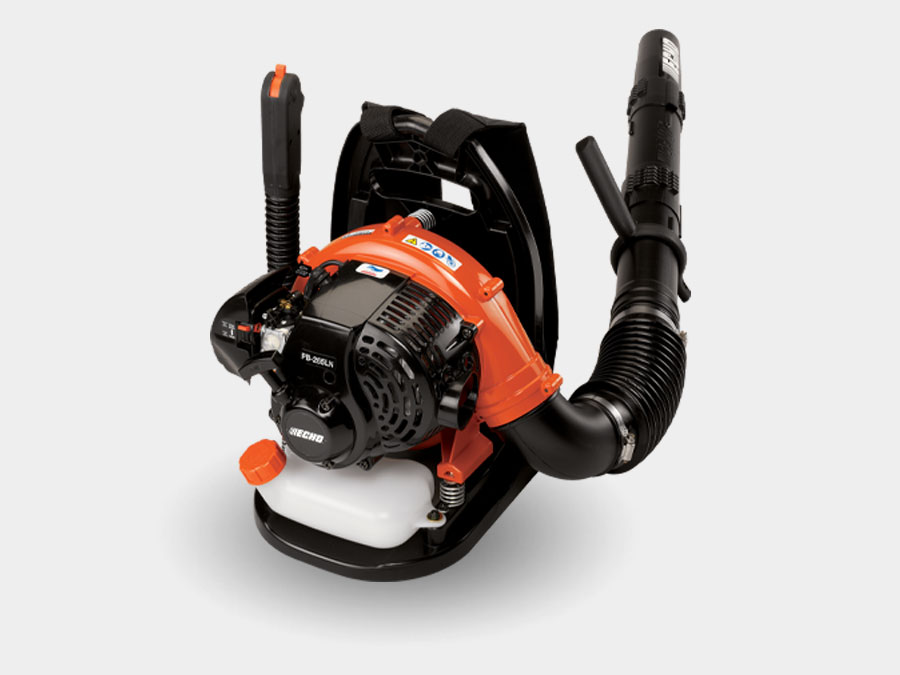
The PB-265LN is a backpack configuration with hip-mounted variable-speed throttle and cruise control. A tube-control backpack is a different handling layout; this page's model identity should not be used as a proxy for that arrangement.
Explore this need in the finder →Is 375 CFM a suitable minimum for a compact backpack blower?
The current product page, current manual and support table agree on 375 CFM, and the manual lists 158 mph maximum with pipes. Larger current ECHO backpack models publish higher airflow, but output ratings do not predict yard clearing time.
Explore this need in the finder →Do you need blowing only, or a vacuum and mulching bag as well?
The PB-265LN is a blower-only model. If leaf collection is essential, compare a documented vacuum/mulcher plan instead of assuming the blower can collect and shred leaves.
Explore this need in the finder →A small-engine backpack with a quiet-work brief
The ECHO PB-265LN takes a different approach from a typical handheld: it straps a 25.4 cc two-stroke blower onto the user's back and puts the variable-speed throttle and cruise control at the hip. That arrangement can feel more natural when you want to guide the tube with your hands without holding the engine body. It is still a low-output backpack compared with larger ECHO models, so the reason to choose it is the combination of harness carry, low-noise positioning and manageable published airflow—not the biggest CFM number.
ECHO lists 375 CFM and 158 mph on the exact page, and the current serial-specific manual supports both. The manual also gives 131 mph as an average air speed with pipes. Those are controlled product ratings, not an estimate of how quickly you will clear wet oak leaves, move gravel, or finish a yard. The PB-265LN sits below the PB-580H/T in ECHO's own published airflow figures, and larger backpacks may suit heavier or more extensive cleanup. For a smaller yard, the backpack can still be worthwhile if you prefer its carrying style to a handheld; for brief jobs, a backpack may be more apparatus than you need.
Hip control and harness use change the feel
The PB-265LN's most practical difference from the PB-255LN is not the engine displacement—both are 25.4 cc—but where the body and throttle sit while you work. The PB-265LN rests on a padded back support with shoulder straps, while its speed control is at the hip and includes cruise control. The handheld PB-255LN leaves the blower body in the operator's hand and lists nozzle-specific results. Neither layout is automatically easier for every person. The backpack's straps must fit and be adjusted properly, and the hip lever is a different control motion from a hand trigger. If you can handle one before choosing, try the strap adjustment and control reach without starting the engine.
The exact page lists 13.3 pounds dry with standard pipes, while the 2020 manual lists 11.5 pounds dry without stating a comparable pipe basis. That gap cannot be settled by calling either number the ready-to-work weight. Fuel adds mass, and the manual does not give a filled working weight in a directly comparable way. The tank's size can also be read inconsistently: page feature copy says 21.3 fluid ounces, but the page specification table, current manual and support data say 22.3. The evidence-backed tank figure is 22.3 fluid ounces; it is not a runtime estimate.
Noise claims need a useful limit
ECHO markets the PB-265LN for noise-sensitive environments and the current page and 04/2020 manual list 65 dB(A) at 50 feet under ANSI B175.2. The ECHO support table lists 64 dB(A). Because official sources disagree, this review does not make the number an essential numeric match. At any rate, a measurement distance of 50 feet does not describe the sound at the operator, guarantee compliance with a local rule, or remove the manual's hearing-protection guidance. Low-noise positioning is a reason to investigate this model, not a claim that it is silent or universally permitted.
The page's i-30 starting system is still a recoil arrangement. The manual's cold-start steps use the stop/throttle control, choke, purge bulb and pull rope. ECHO says its starting system reduces effort, but this is not an electric start and it does not eliminate the 50:1 premix requirement. If you want to avoid mixing fuel, handling fumes and storing an engine, a battery backpack is a genuinely different operating plan rather than a less noisy version of the same machine.
What the gas routine asks of the owner
The current PB-265LN manual specifies 89-octane unleaded gasoline, two-stroke oil at 50:1, and restrictions on methanol, ethanol content and fuel types such as E-15 and E-85. Follow the exact manual for the unit's serial range, including safe fueling, startup, cooling, storage and maintenance. The blower also needs eye and hearing protection and clearance around people and pets. A larger 22.3-ounce tank does not tell you how many minutes a tank will last because fuel use depends on engine load and throttle.
The current ECHO manual X7501186206 covers serial range P43014001001 through P43014999999; ECHO lists a separate 03/2013 manual for earlier P353 and P354 ranges. If you buy used or older stock, check the serial plate before following setup advice. ECHO's recall index lists a PB-265L fuel-line notice, but that exact model name is not PB-265LN; do not transfer the recall to a different suffix without evidence. The index also does not prove serial-level clearance for an individual blower. The current PB-265LN page lists consumer and commercial warranty terms; the actual purchase must satisfy them.
Choose it for the plan, not the name
Choose the PB-265LN when a backpack harness and hip control matter, 375 CFM is enough for the work you describe, and you accept a pull-start gas engine. If you would rather hold the engine in one hand, compare the PB-255LN and its round/flared pipe results. If you need more published airflow and can accept a larger package, compare ECHO's PB-580H or PB-580T; the suffix changes throttle position, not the general backpack work plan. If your priority is avoiding premix and recoil starting, EGO's LB6004 is a battery backpack configuration, but it brings battery-charge planning and a different weight/power setup.
Choose the PB-265LN for its harness and hip-mounted control, not because “backpack” implies high output. Use the supported 375-CFM rating and its gas ownership requirements for ordinary comparison. The exact sound and weight thresholds remain unknown where ECHO's records disagree; do not choose whichever number looks most favorable to meet a strict limit.
Compare the PB-255LN handheld · Read the ECHO PB-580H backpack assessment · Compare the PB-580T tube-control layout · Compare a battery backpack · ECHO PB-265LN product page
Key details at a glance
| Maximum published air volume | 375 CFM |
|---|---|
| Manual-listed maximum air speed | 158 mph |
| Batteries in this kit | 0 |
| Shoulder strap included | Yes |
| Limited warranty | The current exact U.S. product page lists 5 years consumer / 2 years commercial; confirm terms for the specific purchase and use. |
| Exact package configuration | This is the PB-265LN blower model, not a battery kit or vacuum/mulcher. Page feature text says 21.3 fl oz tank while its specification table and manual list 22.3; the supported tank value used here is 22.3 fl oz. |
| String trimmer in kit | No |
| Leaf vacuum and mulching function | No |
| Battery included in package | No |
| Charger included in package | No |
| Blower carrying style | Backpack |
| Backpack support harness | Yes |
| Power source | Gasoline |
| Engine displacement | 25.4 cm³ |
| Fuel tank volume | 0.66 L |
| Air volume at pipe | 375 CFM |
| STIHL Easy2Start | No |
| Gasoline tank capacity | 22.3 oz |
| Two-stroke fuel mixture | 50:1 gasoline and two-stroke air-cooled engine oil meeting ECHO's listed ISO-L-EGD and J.A.S.O. M345-FD specifications. |
| Product-page maximum air velocity | 158 mph |
| Manufacturer-listed weight | 13.3 lb |
| Weight measurement basis | ECHO's exact product page identifies 13.3 lb dry with standard pipes. The current 04/2020 manual lists 11.5 lb dry without stating an equivalent pipe basis; support gives 13.3 lb. No single strict bare-tool weight is inferred. |
| Throttle control location | hip |
Use the exact model’s instructions for operating limits, supplied equipment and version differences.
Sources for this assessment
- ECHO U.S. PB-265LN product page
- ECHO Support PB-265LN specifications
- ECHO technical documents filtered to PB-265LN
- ECHO PB-265LN Operator's Manual X7501186206 (04/2020)
- ECHO PB-265LN Operator's Manual X7501183702 (03/2013)
- ECHO U.S. product-recall document index
- ECHO PB-265LN image embedded on its exact U.S. product page

Match the blower to your yard and routine.
Compare the exact kit, controls, nozzle and carrying setup before choosing.