
Your needs, this model
Does it fit your priorities?
If the BG 50’s lighter handheld format is attractive but an eligible battery substitute is acceptable, what clears the 412-CFM floor under an 8-lb body ceiling?
The BG 50 has an 8-lb before-refueling product-page figure and a 412-CFM round-nozzle maximum, but remains reference-only. If battery power is acceptable, the EGO LB5302 is an eligible handheld alternative with a 530-CFM maximum and a 4.81-lb body figure. That is a different operating plan, not a tested equivalent.
Explore this need in the finder →If the BG 50’s published 13-N force is the attraction, is there a current battery handheld whose manual-listed maximum clears that floor when power source is flexible?
The eligible EGO LB5804 is a battery handheld whose documented maximum blowing force is 18 N, so it clears a 13-N floor. This does not prove it moves the same debris at the same rate in a yard.
Explore this need in the finder →If loose leaves must be vacuumed and collected rather than blown, can this blower do that job?
No. BG 50 is a blower-only tool. If battery power is acceptable, EGO LV5000 and LV5005 are current handheld blower/vacuum/mulcher configurations with a collection bag; compare the exact kit before buying.
Explore this need in the finder →A compact gas handheld with a clear job
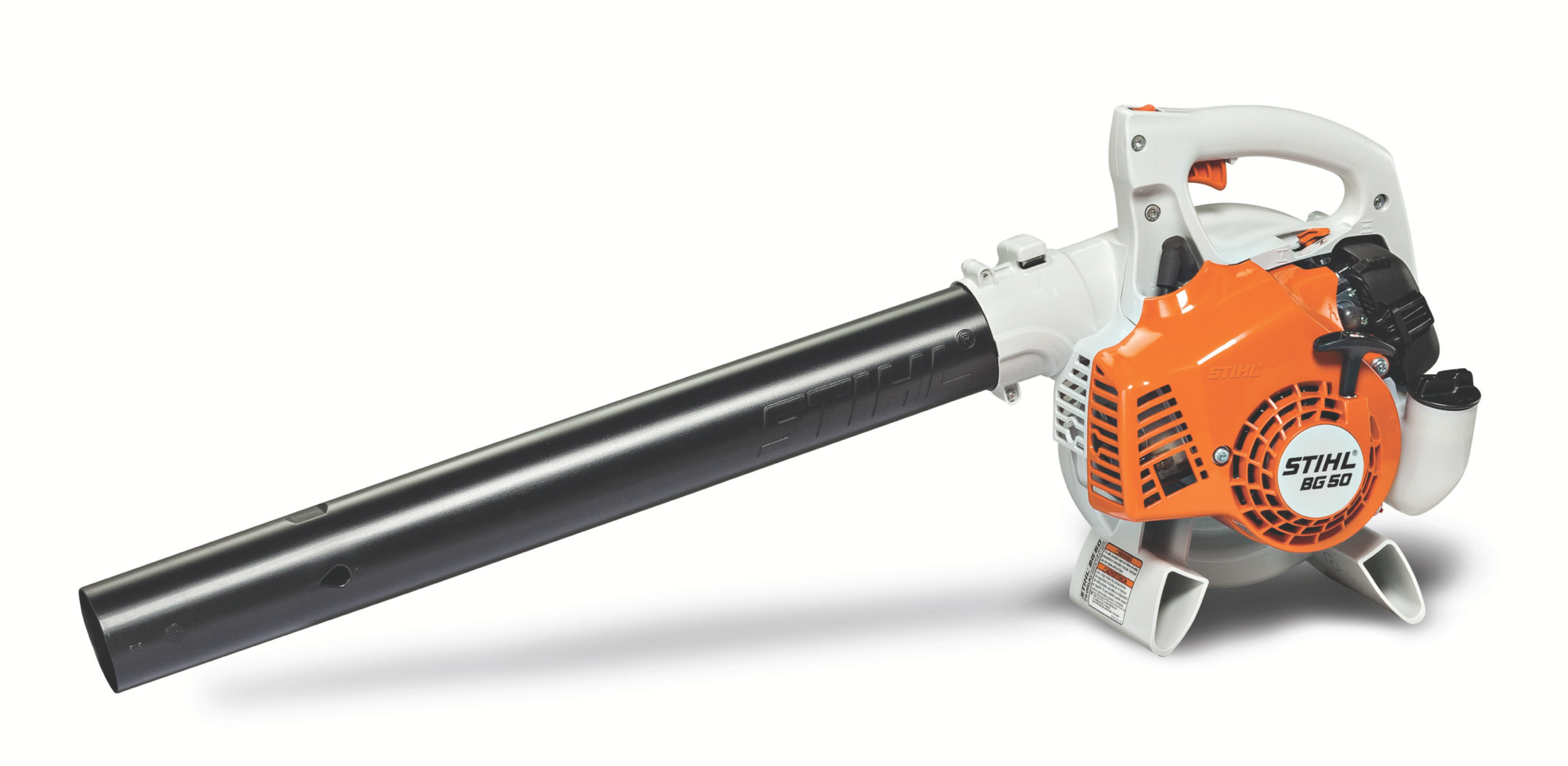
The STIHL BG 50 is a handheld, gasoline-powered blower for routine cleanup: moving dry leaves and grass clippings from a walk, driveway, patio edge or small lawn. Its US part number is 42290111722US. It is not a battery kit, backpack blower or vacuum/mulcher. The exact product page lists a round-nozzle maximum of 412 CFM, 159 mph and 13 N, with an 8-pound device weight before refueling. STIHL’s 2025 product catalogue gives the dry weight as 7.9 pounds, so I use the product-page figure for the finder and treat both as un-fueled body weights rather than an assembled operating weight.
Those output figures are the manufacturer’s published maxima, not a measured clearing-time result. CFM describes a volume figure; air speed and force express other aspects of the stream. None predicts how damp leaves will behave around shrubs or how long a particular yard will take. At 412 CFM, the BG 50 sits below many currently eligible battery models in this library. That does not make it useless: its case is a relatively light gas handheld, with gasoline refueling rather than battery charging and a smaller body weight than the BG 56 C-E.
Starting and carrying are the main tradeoffs
The BG 50 has a manual fuel-pump primer, a trigger and a stop control. The product page describes the primer as helping move fuel to the carburetor before starting. STIHL’s comparison chart does not list Easy2Start for this model, and the product page does not advertise that feature. If easier rope starting is important, the BG 56 C-E adds STIHL’s Easy2Start system; the trade is a published 9.3-pound dry weight instead of the BG 50’s 7.9-pound catalogue figure. The BG 50 is the lighter choice on paper, not the easier-starting sibling.
For an occasional homeowner job, a 14.5-fluid-ounce fuel tank is a smaller capacity than the BG 56 C-E’s 18.3-ounce tank. It does not promise a specific runtime either way. Load, throttle use, fuel and conditions affect consumption, so a tank-capacity preference should not be translated into guaranteed minutes of blowing. The same practical limit applies to the numbers: the two models have the same published 412-CFM, 159-mph and 13-N round-nozzle maxima, so the BG 56 C-E’s extra tank capacity and assisted recoil starter do not mean more listed airflow.
Ownership means mixed fuel, noise and storage habits
This is a two-stroke machine, so its fuel plan differs from a four-stroke mower or a battery blower. STIHL’s BG 50 manual calls for a 50:1 gasoline-to-two-stroke-oil mixture, minimum 89 AKI gasoline and no more than 10% ethanol. The brand recommends fuel with at most 10% ethanol. Use the manual’s fueling and cooling instructions; the tank should not be opened hot. Plan for mixed-fuel storage, filter checks and routine small-engine maintenance rather than simply charging a pack and putting the tool away. STIHL recommends its servicing dealers for repair work beyond the user maintenance described in the manual.
The product page’s quick-access filter cover and translucent upright tank are useful small details: a user can check fuel level and get to the air-filter housing without treating a blower as maintenance-free. A listed 70-dB(A) sound-pressure specification is not a guarantee about sound at a neighbor’s property or at every distance. This is still a combustion engine with exhaust, noise and fuel handling; it is a poor fit where quiet operation, zero emissions at the tool or an effortless start is essential. STIHL says this model is not available for purchase or delivery in California.
How to choose between it and alternatives
Choose the BG 50 only if the gas format, 8-pound body-weight ceiling, basic round-nozzle blowing job and manual pull-start routine all suit you. If battery is acceptable and the goal is an eligible handheld blower above this 412-CFM floor, compare the EGO LB5302 kit for included battery and charger, or the EGO LB5804 kit for a higher published airflow. They use a different battery system and are not measured equivalents; the finder can show them only when your required power source and package choices match.
If you need Easy2Start, the BG 56 C-E is the STIHL sibling to examine, but its exact configuration remains a reference-only record here until exact-model CPSC status is established. The same caution applies to the BG 50: this is a useful technical profile, not a purchase recommendation. A blower alone also cannot collect leaves into a bag. For that job, compare the EGO LV5000 vacuum/mulcher configuration and confirm its battery package and collection setup. The shopping questions treat unknown safety or equipment details as unknown rather than turning a nearby model into a match.
Primary details: STIHL’s BG 50 product page; STIHL BG 50 instruction manual; and STIHL’s 2025 full-line product catalogue.
Key details at a glance
| Maximum published air volume | 412 CFM |
|---|---|
| Manufacturer-listed sound level at 50 ft. | 70 dB(A) |
| Manual-listed maximum air speed | 159 mph |
| Manual-listed maximum blowing force | 13 N |
| Manufacturer-listed tool weight (check basis) | 8 lb |
| Batteries in this kit | 0 |
| Nozzles in the kit | round |
| Shoulder strap included | No |
| String trimmer in kit | No |
| Leaf vacuum and mulching function | No |
| Battery included in package | No |
| Charger included in package | No |
| Backpack support harness | No |
| Power source | Gasoline |
| Engine displacement | 27.2 cm³ |
| Engine output | 0.9 hp |
| Fuel tank volume | 0.43 L |
| STIHL Easy2Start | No |
| Gasoline tank capacity | 14.5 oz |
| Two-stroke fuel mixture | 50:1 gasoline/two-stroke oil |
| Product-page maximum air velocity | 159 mph |
| Weight measurement basis | No fuel; BG 50 current product page says 8 lb without refueling while manufacturer 2025 table/manual say 7.9 lb dry. Matcher uses conservative 8.0 lb; BG 56 C-E exact page/catalogue say 9.3 lb dry/without refueling. |
Use the exact model’s instructions for operating limits, supplied equipment and version differences.
Sources for this assessment

Match the blower to your yard and routine.
Compare the exact kit, controls, nozzle and carrying setup before choosing.